




The rank compares your EP with every possible roll. Trash is the bottom 1%. Common is the bottom 50%. Uncommon is the top 50% through the top 25%, Rare the top 25% to 10%, Epic the top 10% to 5%, Anomaly the top 5% to 1%, and Mythic the top 1%. Beside the band name, the result also prints a tighter percent, so a Common roll can still read bottom 14%.
RNGdle
rngdle gives you one roll a day. Generate draws a number from 0 to 1,000,000, and you do not choose the digits. The site looks for patterns in that number, turns each match into a badge, and adds the badges up as EP, short for entropy points. The EP total is what the rarity rank is based on.
How to Play RNGdle
1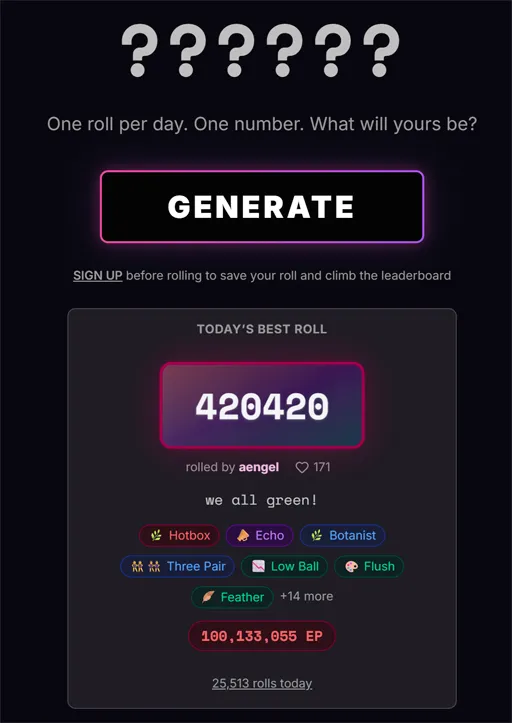
Press Generate
Before the roll, the board is six question marks over the Generate button, plus a card for today's best: the number, who rolled it, badge chips, the EP, and how many rolls have already landed. Your own digits appear only after you press.
2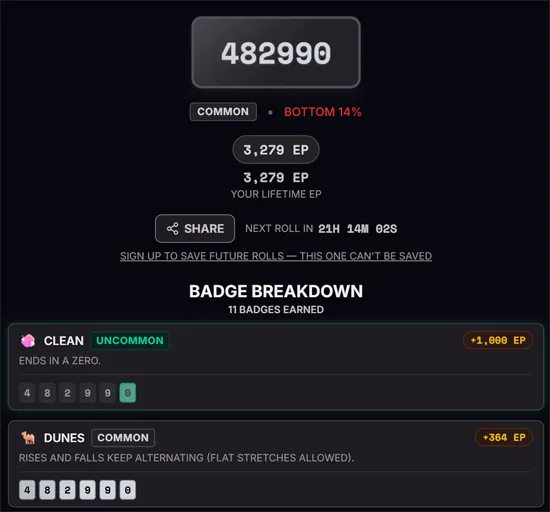
Read the badge lines under the number
Under the digits you get a rarity name, a percentile, the EP for this roll, and your lifetime EP. Each badge line names the pattern, tags its rarity, states the rule, highlights the digits that matched, and shows the EP it added. On one result, Clean (uncommon) fired because the number ended in zero, and Dunes (common) fired because the digits rose and fell, with flat stretches allowed.
3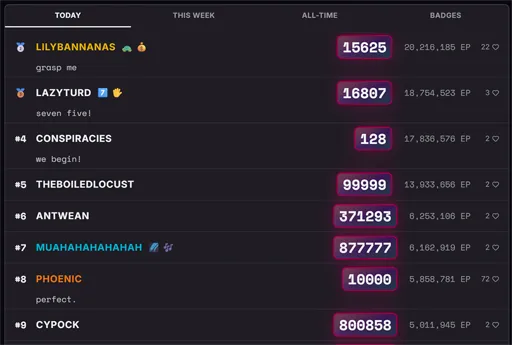
Check the boards, then wait
The tabs are Today, This week, All-time, and Badges. Today lists players beside the number they rolled and the EP on it. Share is on your own result. A clock there counts the hours, minutes, and seconds until Generate opens again.
Where your EP lands
How a badge earns its EP
Badge rarity is separate from the roll's rank. It follows how often that pattern appears. Common is more than 10% of rolls, Uncommon 1% to 10%, Rare 0.1% to 1%, Epic 0.01% to 0.1%, Anomaly 0.001% to 0.01%, and Mythic under 0.001%, which the site puts at 1 in 100,000 or rarer. Rarer badges are worth more EP. The set includes palindromes, primes, repeating digits, meme numbers, and mathematical sequences.
After the digits land
You cannot aim this. Generate does not take a guess, and there is no control that nudges the number. The roll is the whole event, and then you read what you were given. Palindromes, repeating digits, primes, and short sequences are the patterns the badges are naming. After a few days those shapes get familiar, and the result is more fun to parse because you already know what you are looking at. Do not stop at whether the number looks exciting. A boring string of digits can hide one of those patterns, and a flashy one can carry none of them and finish lower. When a roll looks impossible, painfully ordinary, or strangely fortunate, that is the one to send.
FAQs about RNGdle
Sign up before you press Generate if you want the number stored and your name on the board. A roll made while signed out is marked as one that cannot be saved.
No. Nothing you do changes the digits. Generate is one roll, and it stays. There is no second press for a luckier result, and no line of play that pushes the number up.
The rank follows the badges, not how striking the digits look. A quiet number can still be a palindrome, a prime, a repeating run, or part of a sequence, and those are what add EP. A loud number can miss every one of them.