




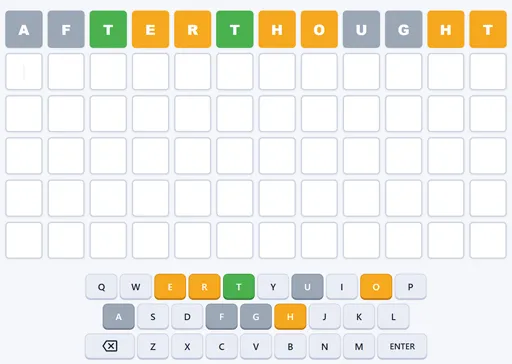
12 Letter Wordle
Word guessing Games like 12 Letter Wordle

12 Letter Wordle

12 Letter Wordle

If shorter Wordle variants still feel comfortable, 12 Letter Wordle is the stress test. The answer stretches across a full dozen columns, which means each guess must be a legitimate twelve-letter word and every bit of feedback has more places to land. Pattern recognition still drives the game, but vocabulary depth and patience matter far more than speed.

On Wordles there is no daily lock. Win, lose, or abandon a round and another puzzle is ready immediately. That makes this mode a strong choice for players who want the hardest letter count on the site, whether you are sharpening formal vocabulary, warming up before a spelling challenge, or simply enjoy the satisfaction of turning a long row of grays into a complete green solution.

How to Play 12 Letter Wordle

1
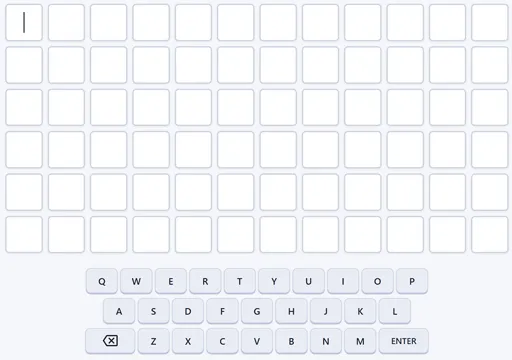
Submitting a twelve-letter opening guess

Enter a twelve-letter word to begin

Use the keyboard or on-screen keys to type a real twelve-letter word, then submit. Openers that spread vowels and common consonants across the entire row tend to reveal more than a guess aimed at a single hunch.

2
Color feedback across twelve Wordle tiles

Decode the color clues

Green tiles lock a letter in place. Yellow tiles tell you the letter belongs somewhere else in the word. Gray tiles remove that letter from future guesses. On a twelve-wide board, scan the whole row before you plan the next attempt.

3

Finish within six rows

Build each follow-up guess around confirmed greens and relocated yellows. Avoid repeating grays. If the sixth row fails, the solution is revealed and you can restart instantly with a new hidden word.

Why twelve letters changes the entire puzzle

Length transforms difficulty in a nonlinear way. Doubling from six to twelve columns does not simply double the work; it multiplies the number of plausible arrangements for the same set of clues. A guess that would feel informative at eight letters might still leave a dozen viable answers here, which is why disciplined note taking beats frantic typing.

Many solutions draw from formal registers: technical terms, compound constructions, and longer everyday words you understand when you hear them but rarely type. That is not a flaw; it is the point. The mode rewards readers, crossword fans, and anyone who enjoys seeing whether their vocabulary can keep pace with the board.

Stretching six guesses across a full row

Six attempts sounds generous until you see how little each guess narrows the field. A productive round often spends the first two words mapping consonant coverage and vowel placement, then uses rows three and four to lock suffix patterns or prefixes. Rows five and six are for convergence, not exploration.

If you enter the final stretch with multiple yellows still drifting, pause and list every column that is not green. Forcing each yellow into a legal new position on paper prevents the last guesses from colliding with rules you already discovered three rows earlier.

Letter coverage without repeating yourself

Repeating letters in a guess is sometimes necessary, but repeating information is not. Once a letter is gray, treat it as gone. Once it is yellow, remember both presence and banned column. High-value openers on twelve tiles often include several vowels plus consonants like R, S, T, L, and N spread apart so the feedback map is easy to read.

Pair your first word with a second guess that introduces fresh consonants instead of reshuffling the same set. Two complementary twelve-letter probes can expose more of the answer than four minor tweaks of the same root.

Making unlimited play worth the effort

Because another puzzle is always one click away, a failed word becomes cheap practice. Read the reveal, identify whether you lost time chasing a wrong suffix or ignoring a yellow, then carry that lesson into the next opener. Over many sessions players often notice familiar endings appearing in their mental checklist before they even type.

That slow accumulation of pattern memory is the real prize. The mode is difficult, but the difficulty is measurable: fewer grays on guess two, more greens on guess four, and occasionally a solve on row five that would have been unthinkable a week earlier.

FAQs about 12 Letter Wordle

The hidden word and every guess must be exactly twelve letters. Among the letter-length variants on Wordles, this is the maximum width and usually the toughest vocabulary challenge.

No. You can start a new game as soon as the current one ends. There is no waiting period tied to a calendar day.

They will not. The game checks each entry against its word list. If the board rejects your input, switch to another twelve-letter word you know is valid.

Hints are optional and best saved for rounds where you are genuinely blocked. They nudge you toward the answer without replacing the deduction work that makes the mode rewarding.

Yes. Enable Hard from the mode menu. Every later guess must include letters you have already confirmed, which is demanding when the word spans the entire row.

Open Create inside the game, type the word you want, and share the puzzle link. The recipient will face that exact twelve-letter target.

Yes. Wins, streaks, and guess distribution for twelve-letter play are stored under their own counters in your browser, separate from other lengths.

Yes. The built-in touch keyboard supports mobile play. The board scales on smaller screens so all twelve tiles remain visible.