










Poople
Word guessing Games like Poople

Poople

Poople began as a back seat distraction. The creators' father built a paper word chain for long drives, and the online version keeps that same blunt goal: walk from whatever four letter starter the calendar hands you to the word POOP using the fewest hops. You are not hunting a mystery answer hidden behind colored tiles. You are building a visible ladder where every rung must be a real word and every rung may change only a single letter from the one below it.

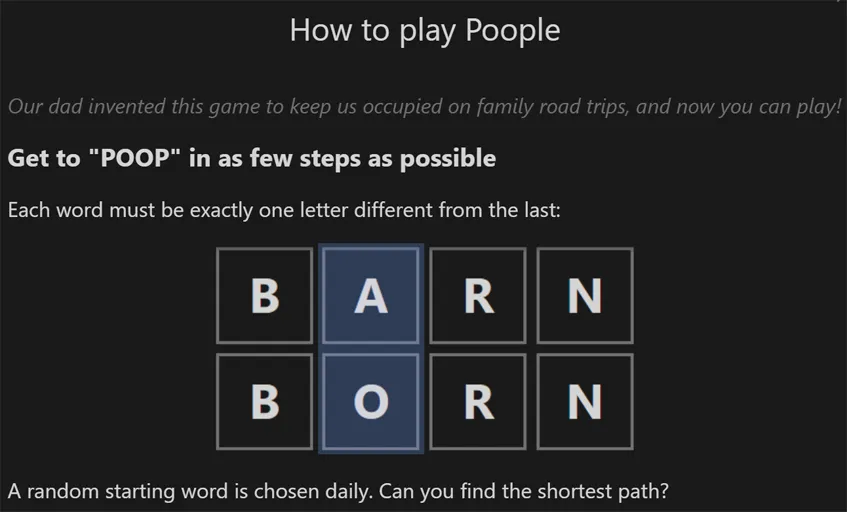
That one letter rule is the whole personality of poople. Turn BARN into BORN and only the vowel moves. Turn KICK into LICK and only the first consonant swaps. Miss the constraint and the board refuses the entry, which saves you from cheating your step count. The puzzle resets daily, so everyone shares the same starting word and the same finish line, then argues about who found the tighter route.

You can also play the daily puzzle on the official site at poople.io.

How to Play Poople

1
Poople puzzle with a daily starting word and rows to fill

Get to POOP in fewest steps

Build a chain of valid words that ends on POOP. Use as few words as you can.

2
Poople one letter difference example between barn and born

Change exactly one letter

Each word must differ from the one above by a single letter, like barn and born.

3

Solve today's daily ladder

A random four letter starting word is chosen each day. Find the shortest path to POOP.

A finish line you can see from mile one

Most word games hide the answer until tiles turn green. Poople flips that tension. You always know you are walking toward POOP, which sounds juvenile until you try bridging from a stubborn opener like WART. Suddenly you care about whether LOOT or PORT opens a faster bridge, because every extra row nudges your average extra guesses upward.

The visible target also changes how groups play in the car. Passengers call out lateral moves aloud, veto illegal double jumps, and celebrate when someone spots a three hop shortcut. Poople rewards planning more than lucky first letters.

Why one letter edits feel harder than they sound

Four letter English is a dense graph. From any node you might have a dozen neighbors, yet only a handful continue toward POOP without trapping you in dead ends. A word that looks clever mid chain can leave you with no legal neighbor except a repeat you already burned.

Veterans think in consonant skeletons. If the starter ends in CK, they hunt early hops that keep hard endings manageable. If the opener is vowel heavy, they lean on silent swaps that preserve rhythm. Poople trains that kind of structural reading faster than a color coded grid because mistakes are rejected outright instead of graded yellow.

Daily numbers and yesterday's replay

Each poople board carries a puzzle number in the header, similar to other daily word sites. Finish today's ladder and the stats drawer records the win, updates streak counters, and shows how many extra guesses you needed beyond the theoretical minimum.

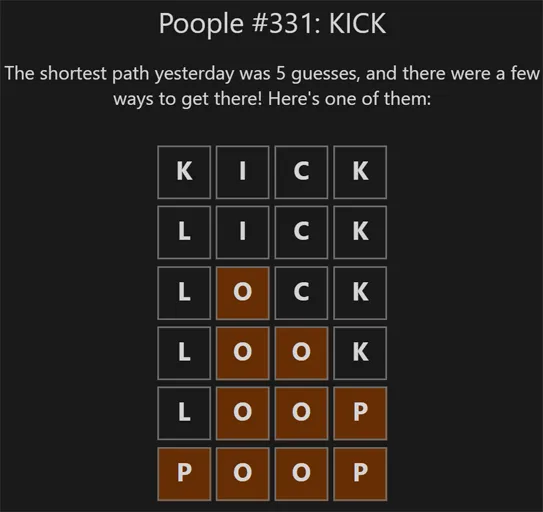
Miss a day and you can still open yesterday's recap. The site animates a shortest path, which might read KICK to LICK to LOCK to LOOK to LOOP to POOP, and notes when several optimal chains existed. That transparency helps newcomers learn routing tricks without spoiling the live starter.

Road trip roots, browser convenience

The family origin story matters because poople never pretends to be a solemn vocabulary exam. It is a silly destination glued to a strict movement rule, which makes it playable for kids who giggle at the endpoint and for adults who treat step minimization like golf par.

Keyboard entry works on desktop, thumb typing works on phones, and the daily reset gives you a reason to reopen the tab tomorrow without clearing an hour long campaign.

FAQs about Poople

You start on a daily four letter word and must reach POOP by submitting a chain of valid words. The win condition is spelling POOP on your last accepted row. Players compete informally on who used the fewest intermediate words, which the game reflects in its average extra guesses stat.

Each new guess must be the same length as the previous word and match it in every position except one. If the prior row reads KICK, LICK is legal because only the first letter changed. LOCK would also be legal from LICK. A jump like KICK to LOCK in one step is not, because two letters moved.

Yes. Every daily puzzle uses POOP as the fixed endpoint. Only the starting word rotates. That constant finish line is what lets players compare routes across days even when the opening string feels friendly or hostile.

When KICK opened the board, one published shortest path ran KICK, LICK, LOCK, LOOK, LOOP, then POOP. Five moves after the starter, six rows total. Other equally short chains may exist, which is why the recap screen sometimes notes multiple optimal routes.

Yes. The site labels puzzles with a daily number and displays one shared starting word. Friends can swap step counts without worrying that someone else began on a different ladder.

The official how to play blurb credits a father who invented the game to entertain kids during family road trips. The browser edition preserves that casual origin while adding scoring, streaks, and a public archive of prior answers.