




Scholardle
Word guessing Games like Scholardle

Scholardle

Scholardle

Scholardle keeps the five letter grid you already know, but it fills that grid with vocabulary pulled from academic life. The hidden answers tend to be terms you meet in journal articles, lab reports, and lecture slides rather than casual chat. You still get six rows to work with, and each guess must be a valid five letter word, yet the solution pool leans on language filtered from large bodies of scholarly text. That single shift makes a familiar format feel sharper for anyone who reads papers for work or study.

One scholardle puzzle arrives each day for everyone playing. When the board closes, you wait for the next term rather than stacking endless rounds. The pace suits people who like a short mental warm up before reading or writing, and it also gives researchers a playful way to test whether they recognize field terms on sight instead of only in context.

How to Play Scholardle

1
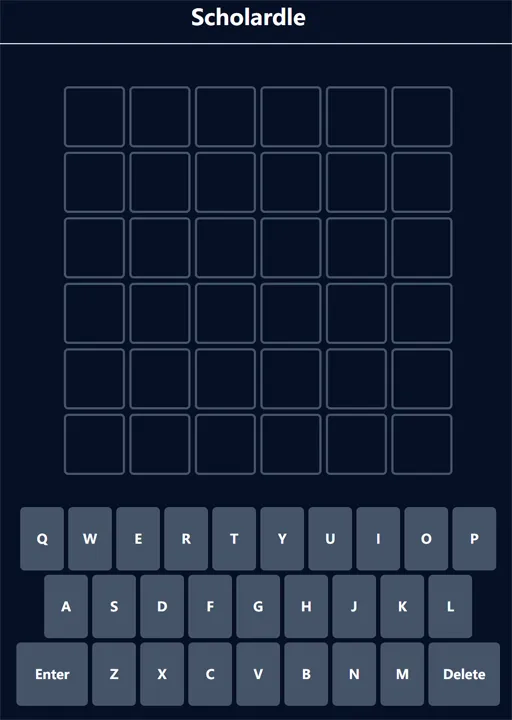
Scholardle empty five letter grid ready for the first academic word guess

Open the daily scholardle board

The puzzle shows an empty five column grid with six guess rows. Type any valid five letter word as your opener. Academic terms often hide unusual consonant pairs, so a balanced starter still helps even when the answer feels specialized.

2
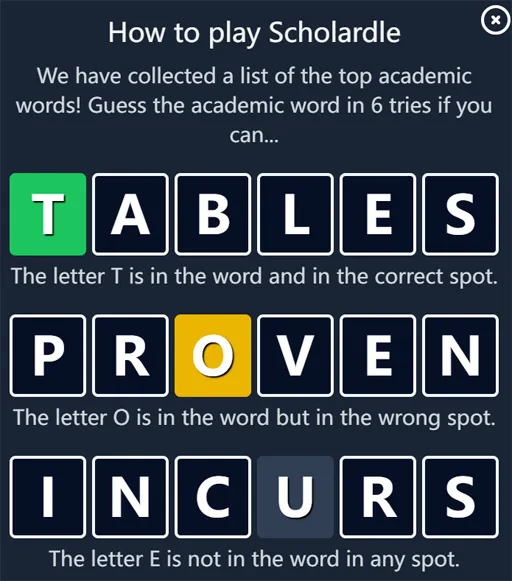
Scholardle board showing green yellow and gray feedback on an academic word guess

Submit guesses and read the tiles

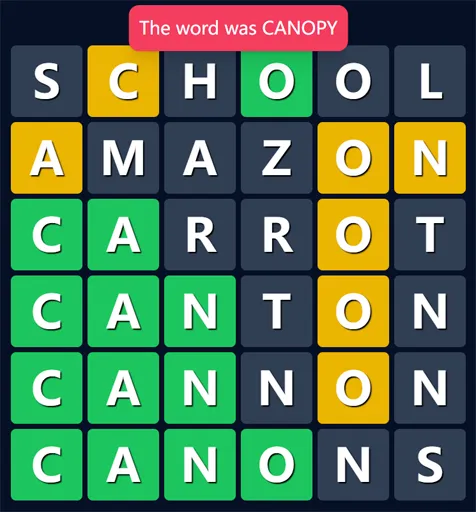
After each entry, tiles turn green for correct letters in the right spot, yellow for letters that belong elsewhere in the word, and gray for letters not in the answer. Use that feedback to narrow the scholardle term within six tries.

3

Solve or review the answer

Fill every slot with green tiles to finish the scholardle round. If all six rows are used without a full match, the solution is revealed. The daily puzzle then locks until the next term is published.

Vocabulary from the reading pile

Scholardle does not ask whether you can spell FRUIT or HOUSE. It asks whether you can land a term that might appear in an abstract, a methods section, or a grant proposal. That focus changes which openers make sense. Letter frequency still matters, but you may notice more Latin roots, clipped technical nouns, and compact verbs that rarely show up in social feeds.

Players who spend hours with PDFs sometimes get an early green simply because a suffix or prefix looks familiar from citations. Others lean on process of elimination when the board turns mostly gray after row one. Both approaches are normal because scholardle rewards general literacy inside academic style writing, not trivia about a single department.

Six rows against a tougher dictionary

The grid layout looks friendly. The answer pool is not. Because scholardle pulls from scholarly usage, the winning word might be obvious once revealed yet invisible while you stare at four yellow tiles. That gap between recognition and recall is the whole difficulty. You know you have seen the term; you cannot quite retrieve it under pressure.

Strong scholardle players often treat early guesses as scouting missions. They sacrifice a row to test rare consonants or to confirm whether a plausible stem appears at all. Saving the sixth row for a confident spelling beats burning it on a hunch pulled from crossword habits that do not match journal vocabulary.

Color feedback on formal spellings

Green, yellow, and gray still tell a clear story. In scholardle, yellow tiles can mislead when two valid academic spellings share letters, so it pays to think about word shape, not only about meaning. A partial match might point to a root you know from biology while the full answer belongs to statistics or education policy.

When several letters lock green late in the round, read the board as a skeleton and say the word aloud. Spoken rhythm catches many scholardle solutions that look wrong on screen because the term is rarely used in conversation. Whispering a candidate before you submit can save your last row.

A small daily ritual for study minded players

Scholardle fits between email and the first chapter of whatever you planned to read. The puzzle is short enough for a coffee break yet just stubborn enough to leave you thinking about letter patterns while you walk to class or commute home. Sharing how many rows you needed gives classmates and colleagues an easy comparison point without spoiling the term itself.

Because everyone receives the same scholardle answer each day, the conversation around it feels like a seminar hallway chat rather than a high score chase. You are not proving reflexes. You are showing whether your academic vocabulary is wide enough to recognize a five letter term when the grid forces you to spell it under a limit.

FAQs about Scholardle

Answers are five letter terms associated with scholarly and scientific writing. They come from vocabulary that shows up frequently in academic publications rather than everyday small talk, which is why many solutions feel unfamiliar outside campus or lab settings.

The rules match the classic six guess format, but the word list targets academic language. You are still spelling on a grid, yet the hidden terms often reflect research usage, making the puzzle harder for players who only know common dictionary words.

You have six guesses to find the daily term. Every submission must be a recognized five letter word. Invalid entries are rejected before the tiles update, so you do not lose a row on a typo that the dictionary does not accept.

Green marks a letter in the correct position. Yellow means the letter is in the word but belongs in a different slot. Gray means the letter is not part of the answer at all. The same color logic applies on every scholardle row until you solve or run out of guesses.

The daily mode offers a single shared puzzle that resets on a twenty four hour cycle. Once you finish or fail that board, you cannot start another official scholardle challenge until the next term drops.

Not necessarily. Exposure to academic reading helps, yet plenty of solutions are general scholarly words rather than narrow jargon. Students, editors, and curious readers often pick up patterns after a week of daily boards.