



Unwordle
Word guessing Games like Unwordle

Unwordle

Unwordle

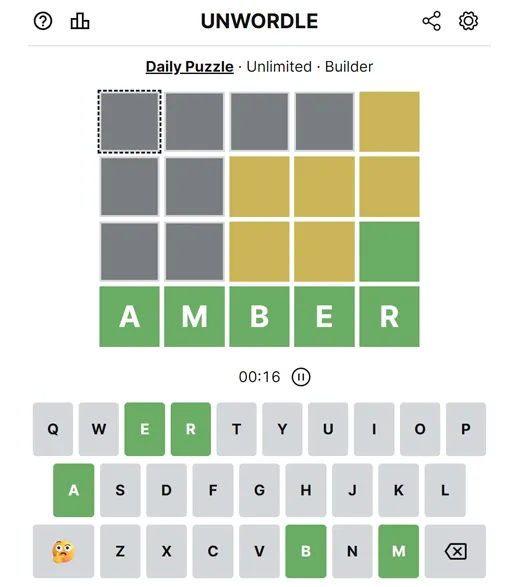
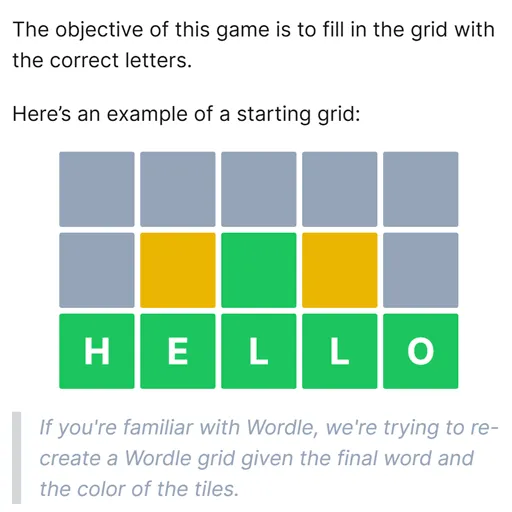
Unwordle flips the standard word guessing format completely. Instead of trying to discover a hidden word through repeated guesses, the final answer is already shown to you in the bottom row with every letter highlighted in green. Your challenge is to work backward and figure out what valid guesses could have led to that final word, using only the color clues provided for each empty row above it. This reverse logic makes Unwordle feel closer to solving a crossword than playing a typical guessing game.

Each row above the solution contains a mix of green, yellow, and gray tiles. Green tiles tell you which letters must stay in those exact positions. Yellow tiles indicate letters that appear in your word but belong in different columns. Gray tiles show positions where the letter in the final word does not belong. Your job is to construct valid words that satisfy all these color constraints simultaneously, filling the grid from bottom to top until every row is complete.

The puzzle tests your ability to think in reverse about how feedback signals constrain word choices. Instead of narrowing down possibilities through trial and error, you need to reason backward from a known solution to reconstruct the logical sequence of guesses that could have produced it. Unwordle rewards careful deduction and pattern recognition in a way that traditional word games do not.

How to Play Unwordle

1
Unwordle game board showing the final word at the bottom with color-coded tiles above

Start by examining the final word and color patterns

The bottom row shows the solution with all letters in green. Look at the rows above it and note which tiles are already colored green, yellow, or gray. Green tiles must contain the same letter as the solution in that exact position. Yellow tiles need a letter from the solution but in a different column. Gray tiles require letters that do not appear in the solution at all. Understanding these patterns before entering any words helps you plan valid guesses more efficiently.

2

Fill each row with words that match the color constraints

Tap or click the row you want to fill and type a valid word. Green letters must stay in their marked positions. Yellow letters from the solution must appear somewhere else in your word. Gray positions need letters that are not in the final word at all. After submitting, the game checks whether your guess satisfies all the color rules. If a red triangle appears in the corner of a tile, there is an error in your entry. Click Show Error Details to see what went wrong and adjust your word accordingly.

3

Complete all rows to solve the reverse puzzle

Work your way up from the row closest to the solution toward the top of the grid. Each completed row brings you closer to finishing the entire puzzle. The logic gets tighter as you move upward, because early rows have more flexibility in how you arrange letters. Once every row is filled correctly with no errors, the puzzle is solved. You can also create custom puzzles or try daily challenges for fresh variations.

Why reverse logic changes how you solve puzzles

Traditional word guessing games let you experiment freely with different words and refine your guesses based on feedback. Unwordle removes that trial phase entirely by showing you the answer upfront. Instead of narrowing down possibilities, you need to figure out what sequence of words could logically have produced the color pattern you see. This backward reasoning is fundamentally different from forward guessing, because every move must justify itself against constraints that are already fixed.

The shift in mental approach is what makes Unwordle feel closer to a logic puzzle than a vocabulary test. You are not searching for unknown information; you are reconstructing a path that is consistent with known facts. Players who enjoy deductive reasoning or constraint satisfaction problems tend to find this format more engaging than those who prefer the open exploration style of standard guessing games.

Reading color constraints more carefully than in forward puzzles

In a typical word game, color feedback tells you what to try next. In Unwordle, the colors define what is and is not allowed in each position. A green tile is an absolute requirement, not just a helpful clue. A yellow tile means you must include that letter but cannot place it where the yellow appears. A gray tile means you must avoid using the corresponding solution letter in that spot. Satisfying all three types of constraints at once in a single valid word is the core challenge.

Players who approach Unwordle as if it were a regular guessing game often get stuck because they treat the colors as suggestions rather than rules. The puzzle works only when you recognize that every tile is a hard constraint that limits which words are valid for that row. Once you adjust to thinking in terms of what is required and what is forbidden rather than what might be correct, the puzzle becomes significantly more approachable.

How working from bottom to top affects difficulty

Starting at the bottom row and moving upward means the first rows you fill have the tightest constraints, because they sit closest to the known solution. This makes the initial steps easier to reason about, since the color patterns are most restrictive near the final word. As you move higher in the grid, the constraints loosen slightly, which introduces more possible word choices and makes those rows harder to pin down.

This gradual increase in difficulty is the opposite of what happens in a standard word game, where early guesses are wide open and later guesses become increasingly constrained. Unwordle frontloads the logic and leaves the more flexible rows for later, which means your opening moves feel more mechanical while the finishing moves require more creative thinking about word construction within looser boundaries.

Using custom puzzles to explore reverse patterns

The custom puzzle feature in Unwordle lets you experiment with different grid configurations and see how various final words produce different color patterns. Creating your own puzzle forces you to think through the reverse logic from the other direction, which builds stronger intuition for what makes a row solvable or ambiguous. If you design a puzzle and then try to solve it yourself, you gain insight into how color constraints interact and which word choices lead to cleaner or messier grids.

Custom mode is also useful for practicing specific types of constraints. You can set up a puzzle where most tiles are gray, forcing you to find words with very few letters from the solution, or create one with mostly yellow tiles to practice rearranging known letters across different positions. This kind of targeted practice is not available in the daily format, where the puzzle structure is predetermined. Over time, working through varied custom setups makes you faster and more confident when approaching any Unwordle grid.

FAQs about Unwordle

Unwordle is a reverse word puzzle where the final answer is already shown to you. Your task is to work backward and fill the empty rows above the solution using color clues. Green tiles mark exact positions, yellow tiles indicate letters that belong elsewhere, and gray tiles show letters not in the solution. The puzzle is solved when all rows are correctly filled from bottom to top.

In a typical word game, you guess repeatedly to discover a hidden word. Unwordle reverses this. You already know the final word, and your job is to reconstruct valid guesses that could have led to it. This requires backward reasoning based on color constraints rather than forward guessing through trial and error.

Green tiles mean the letter in that position must match the solution exactly. Yellow tiles mean the letter exists in the solution but belongs in a different column. Gray tiles require letters that do not appear anywhere in the final word. Every word you enter must satisfy all the color rules for that row.

A red triangle in the corner of a tile signals that your word violates the color rules for that row. Click Show Error Details to see exactly which constraint was broken. You need to revise your word so it matches all the green, yellow, and gray requirements before the row will be accepted as correct.

Yes. Unwordle offers a daily puzzle mode where a new challenge is available every day. You can also create custom puzzles or replay past puzzles, giving you unlimited options beyond the daily format.

It depends on how comfortable you are with reverse logic. Some players find working backward from a known solution easier because the constraints are explicit from the start. Others find it harder because they are not used to thinking about what prior guesses could have produced a given result. The puzzle tests deduction skills more than vocabulary alone.

Yes. Unwordle includes a custom puzzle mode where you can design your own grids and share them. This feature lets you craft specific challenges or experiment with different word patterns and color constraints.

No. Unwordle runs entirely in your browser with no account, download, or sign-up required. The game is free to play on both desktop and mobile devices.