















Airportle
Word guessing Games like Airportle

Airportle

Airportle

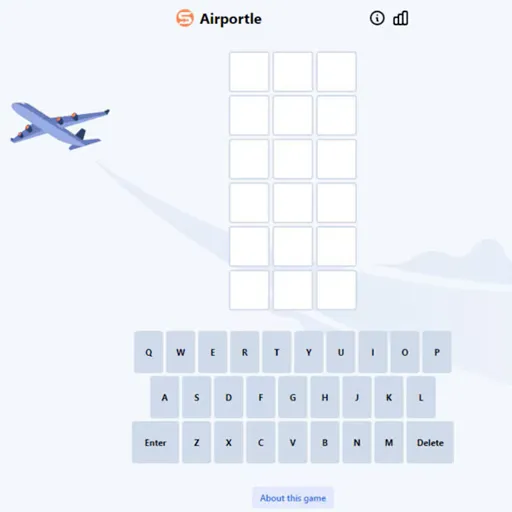
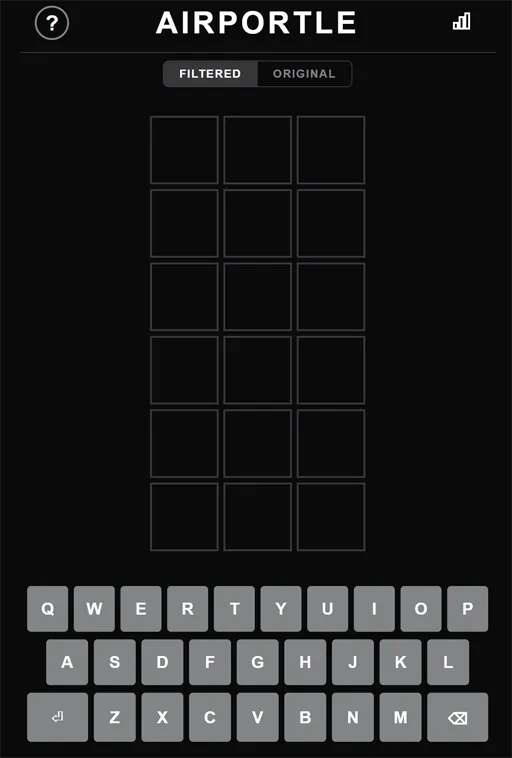
Airportle swaps vocabulary for aviation. Instead of hunting a hidden word, you hunt a three-character IATA airport code tied to a real field somewhere on the map. Six guesses, color feedback after each entry, and one shared daily target for everyone playing that mode. The board feels familiar if you have done tile puzzles before, but the answer pool is built from runways and route codes rather than dictionary entries.

The game comes from the team behind Scott's Cheap Flights, and that travel focus shows in the design. Airportle rewards people who notice which codes appear on boarding passes and baggage tags, yet it still works for casual players who only know a handful of hub abbreviations. You are not spelling a city name. You are pinning down the exact three-symbol label airlines use when they file a flight.

How to Play Airportle

1
Airportle board with a three character IATA code guess entered

Type a valid three-character IATA code

Each guess must be exactly three uppercase characters that follow IATA formatting. Enter a code you think might be today's airportle answer and press submit. Hub codes like LAX or JFK are fair openers when you want a broad test, while regional guesses work if you are chasing a specific geography. Invalid formats are rejected before the tiles update.

2
Airportle tile colors showing green yellow and gray feedback on an IATA guess

Use green, yellow, and gray on the code

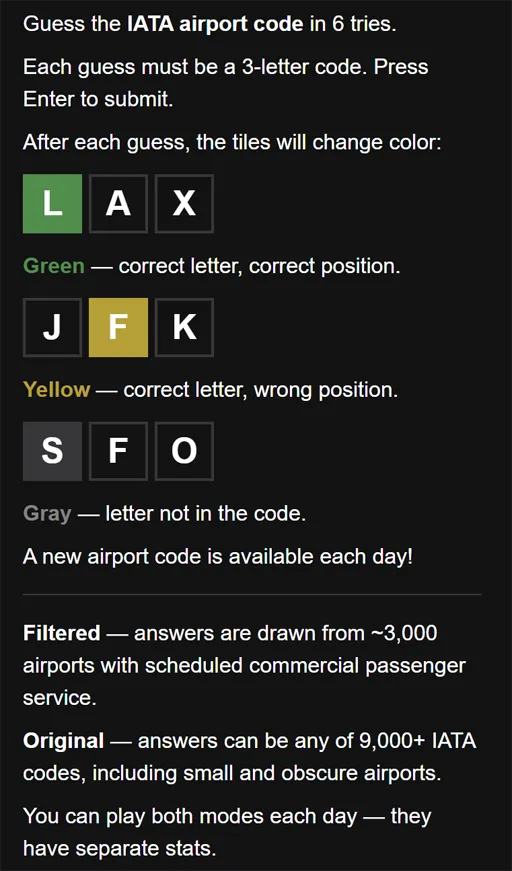
Green locks a character in the correct slot. Yellow means that character belongs in the answer but sits in the wrong position, so shift it on your next try. Gray means it is not part of the hidden code at all. Because airportle answers are only three slots wide, a single green tile can narrow the field quickly when combined with a yellow on another position.

3

Choose a mode and finish the daily airportle

Filtered mode draws from roughly three thousand airports with scheduled passenger service, which keeps codes within a range frequent travelers might recognize. Original mode opens the full catalog of nine thousand plus IATA labels, including small and obscure fields. Both modes post a new puzzle each day and keep separate statistics, so you can play airportle twice on the same calendar date without mixing scores.

Why three characters carry so much geography

IATA codes compress an entire airport into three symbols. LAX is Los Angeles, CDG is Paris Charles de Gaulle, and smaller fields you have never visited still answer to their own labels. Airportle turns that shorthand into the puzzle itself. The search space is tiny compared with a five-slot word game, yet the real world behind each code is huge. Thousands of active airports means even experienced travelers forget more codes than they remember.

That mismatch is what makes airportle click for aviation fans. You are not recalling spelling. You are pulling route memory, map knowledge, and occasional guesswork into a board that punishes random typing as quickly as it rewards a well-placed hub opener.

Two daily puzzles, two difficulty moods

Filtered mode is the friendlier airportle experience. Answers come from airports that still see passenger schedules, so the codes skew toward places people actually fly through. Original mode removes that guardrail. A remote airstrip with a valid IATA label can land as today's target, which turns a confident travel nerd into a humbled guesser fast.

Because stats stay separate, you can treat Filtered as the daily habit and Original as the hard mode side quest. Same interface, same color rules, different tolerance for obscurity. Playing both on one morning is common among players who want a quick win and then a longer shot at bragging rights.

Thinking in hubs, regions, and patterns

Strong airportle openers often test characters that show up across many codes rather than betting on one city. A guess heavy on common aviation initials can surface yellow tiles that point toward a region even when the exact field is wrong. After that, geography intuition takes over. North American hubs behave differently from European fields, and island codes carry their own rhythm once you have seen a few rounds.

With only three slots, permutations run out fast. When two tiles are green and one is yellow, the remaining possibilities might be countable on one hand. Slowing down for that final row beats spraying random codes and burning your last attempts on duplicates you already ruled out.

Built for travelers, not just puzzle streaks

Scott's Cheap Flights built airportle as a playful nod to the codes that appear in deal alerts and booking confirmations. One puzzle per mode per day keeps the habit light. You can finish an airportle round, close the tab, and still make a real flight without falling into an endless loop of extra boards.

For people planning trips, the game doubles as low-pressure code practice. Seeing ORD turn green might remind you how Chicago is labeled on a ticket. Seeing an unfamiliar trio might send you to a map after the reveal. Airportle works as a puzzle first, but the travel context gives each solved code a small story attached.

FAQs about Airportle

You are guessing the three-character IATA airport code for the daily puzzle. Each code identifies a specific airport the way airlines and ticketing systems label it, not the city name spelled out in full.

You get six attempts per daily puzzle. Every guess must be a valid three-character IATA code. If you do not hit the answer within six submissions, the round ends and the correct code is revealed.

Filtered limits answers to airports with scheduled commercial passenger flights, about three thousand codes. Original allows any IATA code in the database, over nine thousand including minor and remote fields. Each mode has its own daily puzzle and its own stats.

Green means the character is correct and in the right slot. Yellow means the character is in the code but belongs in a different position. Gray means the character does not appear in the answer.

Yes. A new airport code arrives on a daily schedule in each mode. Filtered and Original can point to different airports on the same date because they pull from different answer pools.

No. Knowing a few major hub codes helps, but the tile feedback narrows possibilities even when you are new to aviation abbreviations. Many players learn codes gradually by playing the daily airportle puzzle over time.