















Victordle
Word guessing Games like Victordle

Victordle

Victordle

Victordle is a head-to-head word-guessing game built around a simple premise: both players receive the same hidden five-letter word, and whoever identifies it first wins. You can be matched with a random opponent or invite a friend directly. Either way, the goal is the same: crack the word before the other player does.

Each guess must be a real five-letter word. After you submit, the tiles update with colour feedback showing which letters are correct, which are in the wrong position, and which do not appear in the word at all. You have six attempts to find the answer. The pressure of knowing your opponent is working through the same puzzle changes the game entirely compared to a solo word challenge.

Two modes shape how that competition plays out. Turn-Based gives each player up to 30 seconds per guess, with players alternating turns. Duel mode runs both boards simultaneously, letting you see your opponent's progress in real time while you race to submit the correct answer first within six tries.

How to Play Victordle

1
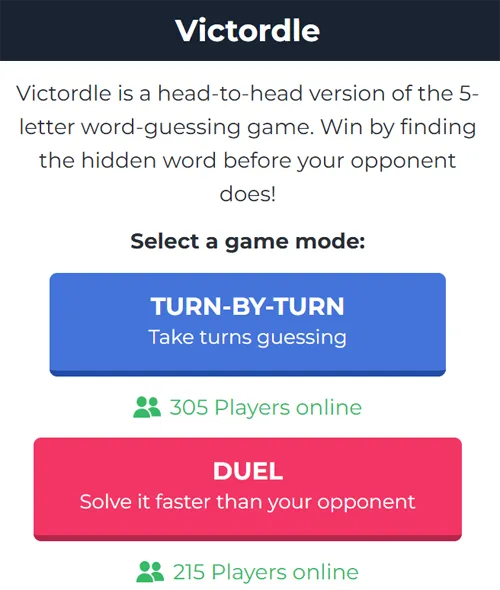
Victordle mode selection screen showing Turn-Based and Duel options

Pick a mode and find an opponent

Select Turn-Based or Duel mode from the main menu, then choose to face a random opponent or invite a friend. Turn-Based alternates turns between players, giving each person up to 30 seconds to submit a guess. Duel mode places both players on side-by-side boards and runs simultaneously, so you can watch your opponent's progress unfold in real time while you work through your own guesses.

2
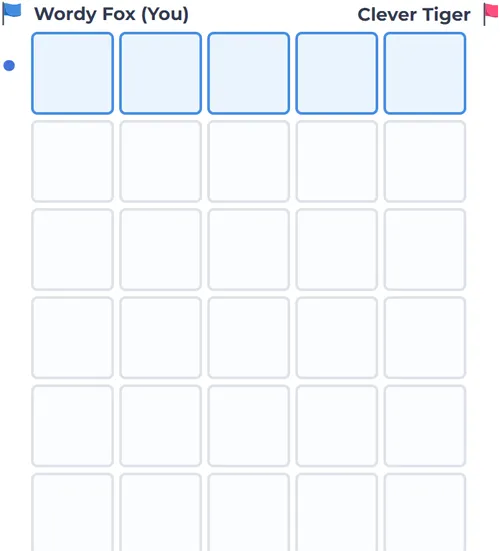
Victordle game board showing colour-coded letter feedback after a guess

Type a real five-letter word and press Enter

Every guess must be a valid five-letter word. After you submit using the Enter button, the tiles change colour to show what each letter means. A green tile means the letter is correct and in the right position. Yellow means the letter is in the word but placed incorrectly. Grey means the letter does not appear in the hidden word at all. You have six guesses to find the answer.

3
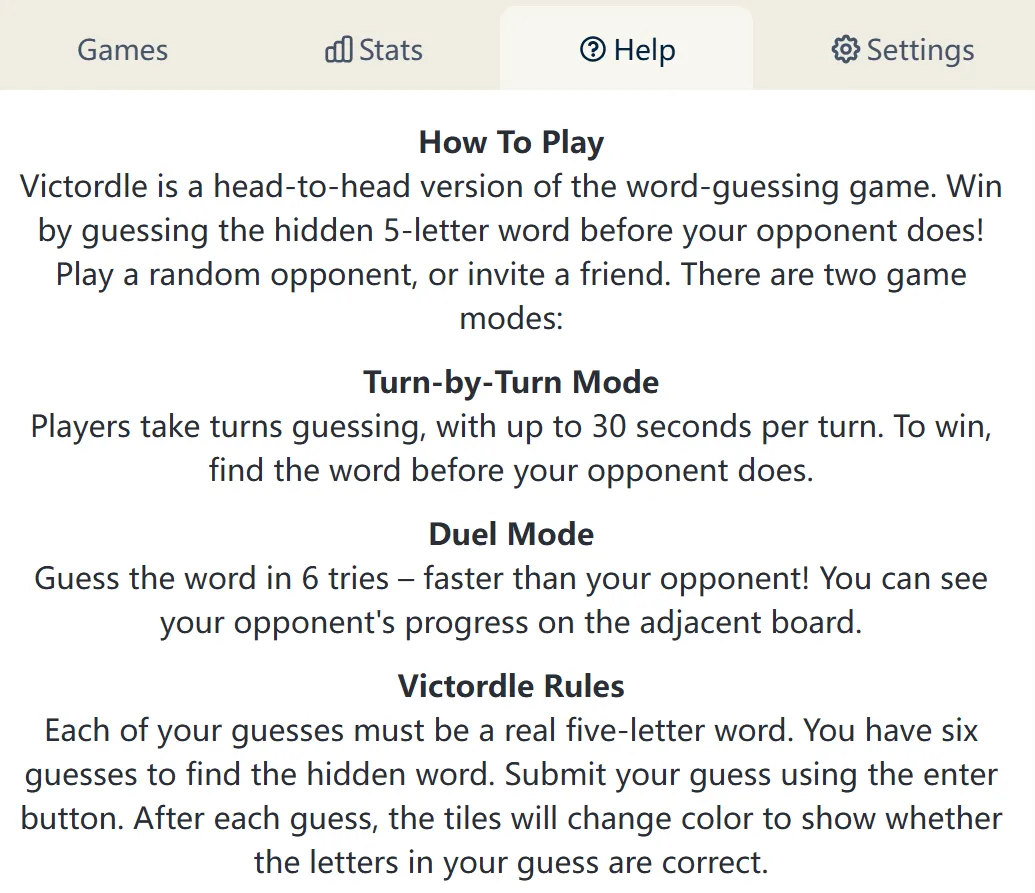
Victordle win screen showing the result after guessing the hidden word

Reach the answer before your opponent does

In Turn-Based mode, the player who correctly identifies the word first across alternating turns wins, with each turn capped at 30 seconds. In Duel mode, both players race through up to six guesses simultaneously, and the one who submits the correct answer first takes the round. Whoever solves it with fewer attempts, or simply faster, walks away with the win.

Why competition changes how you think about words

Playing a word game alone gives you the freedom to sit with a clue and think it through at your own pace. Adding an opponent removes that luxury. In Victordle, the awareness that another player is working through the same puzzle introduces a layer of pressure that changes the way you process clues. Moves that would feel perfectly reasonable in a solo game start to feel slow when you know someone else might be submitting their winning guess at the same moment.

This pressure tends to expose weaknesses in guessing habits that single-player modes never reveal. Players who rely on a slow process of elimination often find that their approach, while effective, is simply too methodical for a timed competition. Victordle rewards players who can extract maximum information from each guess quickly, which means thinking about letter placement and frequency rather than just recognising familiar words.

Choosing between Turn-Based and Duel

The two modes suit different styles of play and different relationships between opponents. Turn-Based is better suited to players who want to feel the strategic side of the game. With 30 seconds per guess and an alternating structure, there is time to analyse the board properly between turns, and the outcome is more directly tied to the quality of each individual decision. A well-chosen second guess that eliminates five possible letters will consistently beat a faster but less informative guess in this format.

Duel mode compresses everything. Both players are moving at once, there is a hard cap on the total time available, and the winner is whoever reaches the answer faster across the full run of guesses. Some players find this format more exciting because the tension is constant rather than intermittent. Others prefer Turn-Based because it more clearly rewards vocabulary and logic over reaction speed. Neither mode is objectively harder; they simply test different things.

Getting an edge on your opening guess

The opening guess in any five-letter word game is about gathering information efficiently, and this is doubly true in a competitive setting where you cannot afford to waste an attempt. Words that spread common vowels and consonants across all five positions tend to produce the most useful colour feedback on the first row. A guess that returns three or four coloured tiles immediately puts you in a strong position going into your second attempt.

In Duel mode especially, a strong opening word matters not just for the information it returns but because it sets the pace. If your first guess produces four green and yellow tiles while your opponent gets two, the subsequent guesses become much more manageable for you and much more difficult for them. The gap can open or close quickly in a six-guess format, but a well-chosen opener gives you the best possible start.

Reading your opponent as a clue

In Turn-Based mode, you can see when your opponent submits a guess and, depending on the interface, observe some information about how their board is progressing. Noticing that an opponent is taking their full 30 seconds suggests they are working through something uncertain. An opponent who guesses quickly in the early rounds is either very confident or relying on a fixed opening strategy rather than reactive logic.

Neither behaviour tells you the answer directly, but these signals can inform your own pacing. If your opponent appears to be narrowing in on the word based on their speed, increasing your own tempo might be worthwhile even at the cost of a slightly less optimal guess. Victordle is ultimately a competition, and the goal is to finish first, not to find the most elegant path to the answer.

FAQs about Victordle

Victordle is a competitive word-guessing game where two players try to identify the same hidden five-letter word. The player who solves it first, or in fewer guesses within the time limits, wins the round.
Turn-Based mode alternates guesses between players, giving each person up to 30 seconds per turn. The winner is whoever finds the word first across the alternating sequence. Duel mode is simultaneous: both players work on adjacent boards at the same time and can see each other's progress. You have six guesses to identify the word faster than your opponent. Turn-Based tends to feel more methodical, while Duel is a direct race.
Both modes allow up to six guesses to identify the hidden word. In Duel mode you also have a 60-second time cap across all six attempts, so running out of time ends the round even if guesses remain.
Yes. You can invite a specific friend to a match or be paired with a random opponent. Both options are available from the main menu before the round starts.
The target words are standard five-letter English words. The same word appears on both boards in a given round, so both players are always working on an identical puzzle.
Yes. Green means the letter is in the correct position, yellow means the letter is in the word but placed incorrectly, and grey means the letter does not appear in the word at all. The logic is identical to the standard word-guessing format.
Each individual guess in Turn-Based mode has a 30-second limit. If you do not submit a guess before the timer runs out, your turn passes to the opponent. There is no overall round timer in this mode.
No account or download is required. Victordle runs entirely in your browser and is free to play.