











Nerdle
Word guessing Games like Nerdle

Nerdle

Nerdle

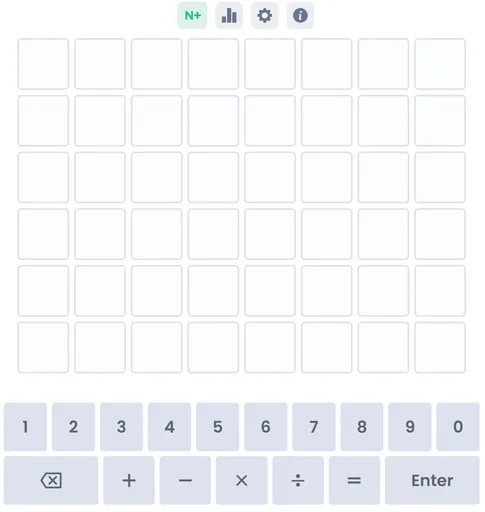
Nerdle replaces letters with numbers and mathematical symbols. Instead of guessing a hidden word, you construct a complete equation using digits from 0 to 9 and the four basic operators: addition, subtraction, multiplication, and division. Each equation must include an equals sign and produce a mathematically correct result. The standard puzzle uses eight characters, though other variations exist with shorter or longer formats. You have six attempts to match the target equation exactly.

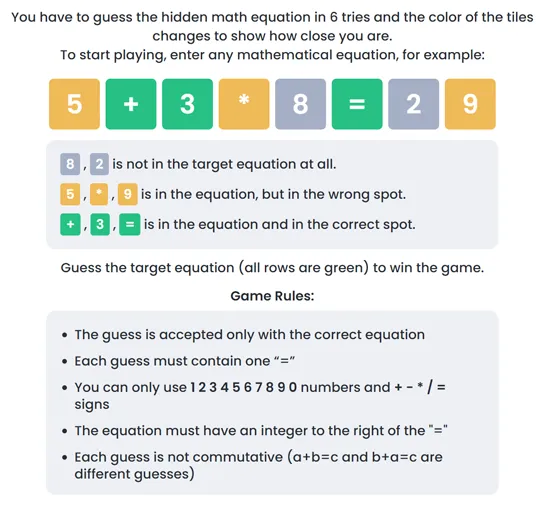
The feedback system mirrors what you expect from word puzzles but applies it to arithmetic. A green tile means the number or symbol occupies the correct position. Purple indicates the element appears in the equation but sits elsewhere. Gray tells you that character does not belong in the solution at all. The daily puzzle updates at midnight, giving everyone the same challenge to solve and share. Because every guess must be a valid equation, the puzzle tests both your arithmetic fluency and your logical reasoning about how numbers and operations fit together.

What makes Nerdle distinct from other number games is the constraint that forces every entry to balance as a true equation. You cannot simply type random digits and symbols to fish for clues. Each guess needs to satisfy the rules of arithmetic before the system will accept it. This requirement turns the puzzle into a more deliberate exercise in constructing valid expressions while applying the color feedback from previous attempts. The combination of math accuracy and pattern deduction is what gives Nerdle its character.

How to Play Nerdle

1
Nerdle game board showing an eight-character equation being entered

Enter a mathematically valid equation

Type an eight-character equation using numbers and operators. The equation must include exactly one equals sign, followed by a single number on the right side. Follow standard order of operations where multiplication and division are calculated before addition and subtraction. Your first guess should test common digits and at least two different operators to gather broad information about which elements appear in the target equation.

2

Read the color feedback carefully

After you submit, each tile changes color. Green means the digit or operator is correct and in the right spot. Purple means it exists in the equation but belongs in a different position. Gray means that character does not appear anywhere in the solution. Use this information to adjust your next guess. The equals sign usually sits in a predictable slot, often the sixth or seventh character, which helps structure your reasoning about what comes before and after it.

3

Solve the equation within six guesses

Each subsequent guess must still be a valid equation, so you are always building arithmetically correct expressions while narrowing down the answer. Keep green tiles in place, relocate purple ones, and avoid gray characters entirely. When all tiles turn green, you have matched the target equation and completed the daily challenge. You can share your result grid without revealing the actual numbers, allowing others to see your solve path without spoiling the answer.

Why requiring valid equations changes your strategy

In a typical guessing game, you can submit almost any combination of characters as long as it forms a real word or recognizable pattern. Nerdle adds a harder constraint by requiring every guess to be a mathematically correct equation. That rule fundamentally alters what strategies are available to you. You cannot simply arrange digits and operators to maximize new information if the result does not balance arithmetically.

This means early guesses in Nerdle require dual thinking. You are trying to construct something that satisfies the rules of arithmetic while simultaneously testing which digits and operators appear in the target. Players who are comfortable rearranging numbers into different valid expressions tend to make faster progress than those who find the arithmetic constraint more restrictive. The puzzle rewards fluency with basic math operations as much as it rewards logical deduction.

Using the equals sign as a structural anchor

The equals sign in Nerdle is the one symbol whose position often follows a predictable pattern. In most eight-character puzzles, it sits in the sixth or seventh slot, which means the left side of the equation contains five or six characters and the right side holds a one or two-digit result. Recognizing this structure early helps you organize your guesses around a clear framework rather than treating the equation as an unstructured string of symbols.

If your first guess places the equals sign in a certain position and it comes back green, you have immediately constrained the shape of all future guesses. If it comes back purple or gray, you know the structure is different and can adjust accordingly. Paying attention to where the equals sign lands is one of the most efficient ways to narrow down possibilities quickly, because it divides the equation into distinct left and right sections with different constraints.

Balancing information gathering with equation validity

A common tension in Nerdle is deciding whether to use a guess that tests many new digits and operators or one that confirms a strong candidate equation you have already partially constructed. Testing broadly gives you more clues but might not advance you toward the answer if most of those symbols turn out to be gray. Confirming a narrower hypothesis wastes fewer guesses but risks missing information if your hypothesis is wrong.

Experienced players often use the first guess to cover a wide range of digits and at least two operators, treating it as pure information gathering. The second guess incorporates that feedback and begins locking in green tiles while testing a few additional possibilities. By the third guess, enough structure is usually confirmed that you can focus on refining specific positions rather than exploring broadly. This progression from wide to narrow is what makes efficient solvers faster than those who guess more randomly.

How daily practice builds arithmetic pattern recognition

Playing Nerdle regularly exposes you to repeated patterns in how numbers and operators combine within the eight-character format. Certain digit combinations appear more frequently because they produce clean results that fit the puzzle structure. Multiplication and division often pair with smaller numbers to avoid exceeding two-digit results. Addition and subtraction allow more flexibility but still follow predictable balancing rules.

Over time, this repeated exposure builds an intuition for which equations are structurally plausible and which are less likely. You begin recognizing that certain operator placements feel right because you have seen similar arrangements before. This pattern recognition is what separates players who solve in three guesses from those who consistently need five or six. The daily format reinforces these patterns without requiring deliberate study, making the learning process feel natural rather than forced.

FAQs about Nerdle

Nerdle is a daily math puzzle where you guess a hidden equation using numbers and operators. You have six attempts to find the correct eight-character expression. Each guess must be a valid equation, and color tiles after every submission tell you which digits and symbols are correctly placed, misplaced, or absent from the solution.

You can use the digits 0 through 9 and the operators for addition, subtraction, multiplication, and division. Every equation must include exactly one equals sign. The number on the right side of the equals must be a single result, not another expression. All standard rules of arithmetic apply, including order of operations.

Green means the digit or operator is in the correct position. Purple means it appears in the equation but is currently in the wrong spot. Gray means that character does not exist in the solution. These signals work the same way as in word guessing games, but applied to mathematical symbols instead of letters.

Nerdle only accepts equations that are mathematically correct. If your expression does not balance or violates the order of operations, it will be rejected. This constraint is intentional, as it ensures every guess contributes meaningful information about the structure of the target equation rather than serving as random symbol testing.

You get six guesses per puzzle. Each one must be a complete and correct equation. If you do not match the target within six attempts, the round ends and the answer is revealed. Most players who understand basic arithmetic and apply the color clues systematically can solve the puzzle in three to five guesses.

Yes. The classic version uses eight characters. Mini Nerdle uses six for faster rounds. Micro Nerdle uses five. Maxi Nerdle extends to ten characters and may include brackets or exponents. There are also challenge modes where you solve multiple boards simultaneously or race against a timer. Each variation adjusts the difficulty and length while keeping the core mechanic intact.

It depends on your comfort with arithmetic. The math itself is not advanced; basic operations are all you need. The challenge comes from the requirement that every guess must be a valid equation, which limits your options more than a game where any dictionary word is acceptable. Players who think methodically about number relationships tend to find it manageable and engaging.

No. Nerdle runs entirely in your browser and is free to play. No account, download, or sign-up is required. The game works on desktop, laptop, tablet, and mobile devices.