






Antiwordle
Word guessing Games like Antiwordle

Antiwordle

Antiwordle

Most word games reward you for reaching the answer quickly. Antiwordle flips that entirely: the longer you avoid guessing the hidden five-letter word, the better you do. Every guess has consequences, and those consequences narrow your options whether you like it or not. Gray letters are banned from future guesses. Yellow letters must appear somewhere in your next word. Red letters are locked into their position and cannot be moved. A new puzzle resets each day.

The result is a tug-of-war between vocabulary and self-preservation. You need to know enough words to keep submitting valid entries while steering away from anything that might accidentally hit the target. The antiwordle game ends the moment you land on the correct word, so the real challenge is staying one step away from being right for as many rounds as possible.

How to Play Antiwordle

1
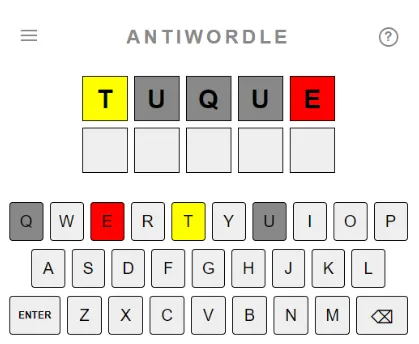
Antiwordle first guess showing gray, yellow and red tile feedback

Submit a valid five-letter word, then read the color response

Type any real five-letter English word and press Enter. Gray tiles mean that letter is not in the hidden word. Yellow tiles confirm the letter belongs somewhere in the word but not where you placed it. Red tiles mean the letter is in exactly the right spot and is now locked permanently in that position.

2
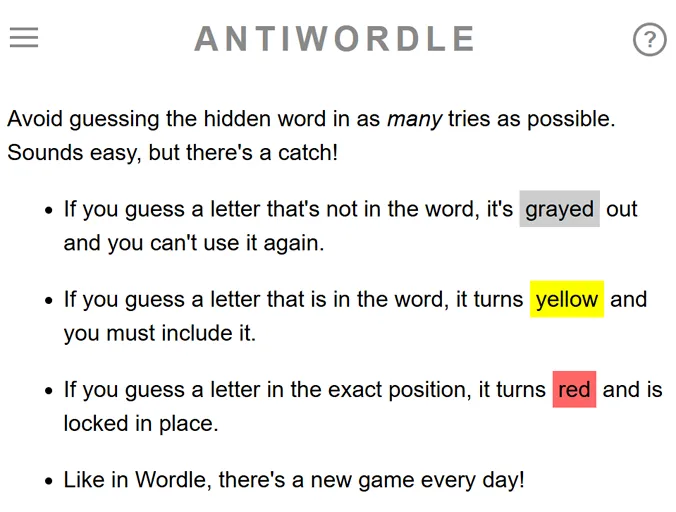
Antiwordle locked red letters and forced yellow letter rules

Follow the forced rules and plan your escape

Gray letters disappear from the keyboard and cannot be reused. Yellow letters must appear in your next guess. Red letters stay locked where they fell and must be included in the same position every time. Work around these constraints to stay alive as long as you can without stumbling onto the answer.

3

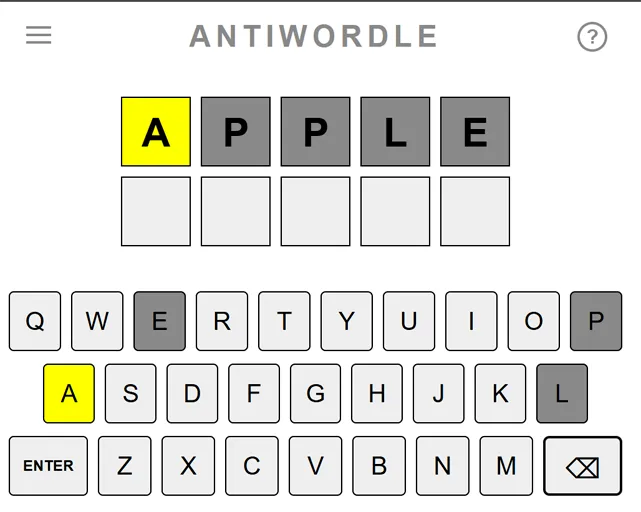
Survive as many guesses as possible

There is no set number of lives. Antiwordle runs until you correctly identify the hidden word. The higher your guess count at that point, the better your result. A new five-letter target appears each day, so the challenge resets with fresh possibilities.

Why Antiwordle is harder than it sounds

The premise seems straightforward: just avoid guessing the word. But the rules enforce a structure that works against you from the first turn. Gray letters leave the keyboard. Yellow letters must return. Red letters anchor in place. Each round you complete, your workspace shrinks and the remaining valid words edge closer to the hidden answer.

The antiwordle game is not purely random avoidance. At some point the locked letters and mandatory inclusions constrain you so tightly that the correct word becomes the only valid option left. Getting there in as many steps as possible is the actual skill being tested, and it requires a different kind of vocabulary awareness than most word games develop.

Opening with uncommon letters

In standard Wordle, opening with a word like CRANE or SLATE makes sense because those letters appear frequently and generate useful feedback quickly. In Antiwordle that logic runs in reverse. Common letters are dangerous because they are more likely to appear in the hidden word, and a yellow or red result immediately restricts what you can play next.

Openers that lean on low-frequency consonants and limit vowels tend to survive longer. The goal is not to gather information but to generate gray tiles without accidentally confirming anything important. A word like FUZZY or QUEUE hits letters that rarely appear in five-letter targets, buying you a round with minimal constraint on your next move.

Managing forced yellow letters

When a letter turns yellow you are required to include it in your next guess, but you have some control over where it goes. The one rule is that it cannot return to the column where it just appeared. That restriction is actually useful: placing it in a position where it is unlikely to be correct gives you a yellow again rather than a red, keeping you in a flexible zone where the letter must be carried forward but is not locked down.

The danger comes when multiple yellows accumulate. Two or three forced inclusions with several locked red positions can leave you with very few words that meet all the constraints while still avoiding the answer. Planning two or three guesses ahead rather than reacting to each turn individually helps stretch out the round.

Playing around locked red positions

Red tiles are the most restricting outcome in Antiwordle. A letter that locks into position must appear there in every future guess, and if the hidden word has common letters in easy-to-confirm positions, The antiwordle game can close in quickly. The key is to accept the locked letters early and pivot strategy around them rather than fighting the constraint.

Once one or two letters are red, focus your energy on finding words that satisfy the locked positions and the mandatory yellows while introducing fresh letters in the remaining slots. Obscure but valid words that fit an unusual pattern become genuinely valuable here, because they extend the session without accidentally completing the word. The broader your vocabulary, the more routes you have through a tightly constrained board.

FAQs about Antiwordle

The goal is the opposite of standard Wordle. You are trying to avoid guessing the hidden word correctly for as many turns as possible. The antiwordle game ends when you accidentally or inevitably land on the right answer, so a higher guess count is a better result.

Gray means the letter is not in the hidden word and is removed from the keyboard permanently. Yellow means the letter is in the word but in the wrong position, and you must include it in your next guess. Red means the letter is correct and in the right place, locking it into that column for all future guesses.

No. Once a letter goes gray it is blocked from the keyboard entirely. This rule progressively shrinks your available letters, making it harder to construct new words that stay away from the hidden answer.

Yes. Yellow letters are in the hidden word, so The antiwordle game forces you to keep using them. You can place them anywhere except the column where they just appeared, but they must be present in every subsequent entry.

It locks into that exact position for the rest of The antiwordle game. Every future guess must contain that letter in the same column. Multiple locked red letters can make it increasingly difficult to form words that avoid the complete answer.

Yes. The hidden word changes daily, matching the rhythm of the classic daily Wordle format. Share your turn count with others to compare how long each person managed to hold out.

Start with a word that uses uncommon letters and few vowels. The more rare letters you use early, the less likely you are to accidentally confirm a common letter that pulls you toward the hidden word. Avoiding E, A, R, S, and T in your first guess is a reasonable starting point.

Yes. Antiwordle runs in a browser on phones and tablets without any download or account required.