


6 Letter Wordle
Games similar to 6 Letter Wordle

6 Letter Wordle

6 Letter Wordle

Six-letter Wordle keeps the familiar structure of the original but stretches the target word by one column. That single extra letter opens the vocabulary considerably and forces you to think about less common endings and prefixes alongside the usual suspects. Players who feel the five-letter version has grown too familiar often find this variant genuinely refreshing, because the answers sit in a part of English where intuition alone rarely closes the deal.

On this page there is no daily limit. Each game ends and a new one is waiting, which means you can play at whatever pace suits you without watching a clock or waiting until tomorrow. The board, keyboard, and feedback colours all work exactly as you would expect, so there is no relearning involved if you have played any Wordle variant before.

How to Play 6 Letter Wordle

1
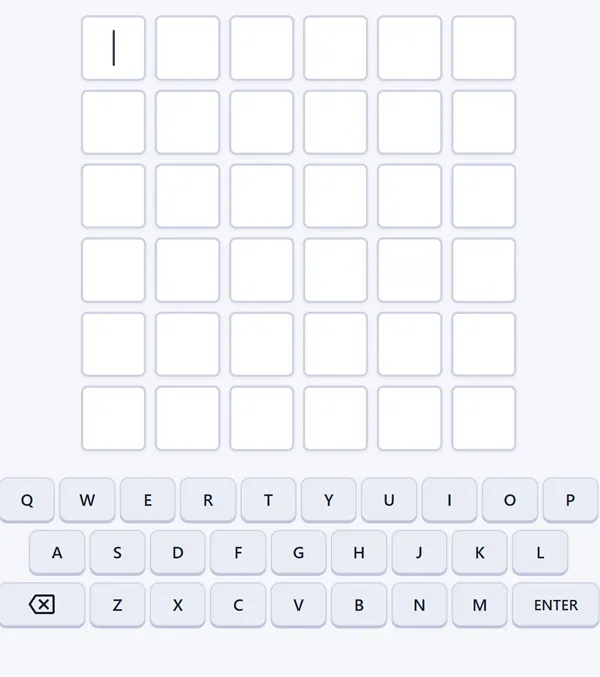
6 Letter Wordle opening guess on the board

Enter a six-letter word to open

Type any valid 6-letter English word using the on-screen keyboard or your physical keys, then press Enter. A strong opener covers at least two vowels and spreads common consonants across different positions.

2

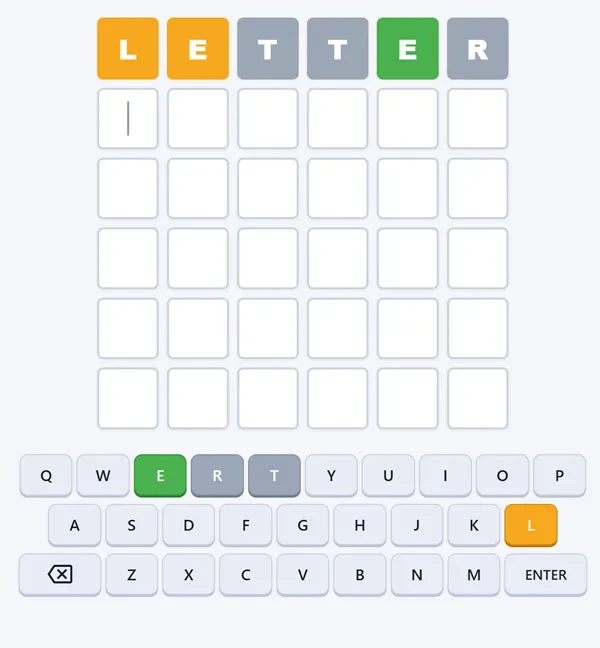
Read each tile colour carefully

Green means that letter is correct and in the right spot. Yellow means the letter is in the word but sits somewhere else. Grey means the letter does not appear in the word at all. Pay attention to every position, not just the greens.

3

Narrow down with each subsequent guess

Build on what you know: keep green letters fixed, move yellow letters away from their current position, and exclude grey letters from new guesses. You have six attempts in total. The extra letter length means the answer space is wider, so use early guesses to gather broad information rather than chasing a specific word too soon.

Why six letters changes the game

Moving from five letters to six does more than add one tile. English has a large number of six-letter words built around suffixes like -tion, -ness, -ment, and -ing, so a single confirmed ending can unlock or completely redirect your search. At the same time, those common patterns create traps: two yellow letters that look like the start of -ation might belong to an entirely different arrangement. The extra column gives you more confirmed information per guess when things go well, but it also means a poorly chosen opener leaves a wider open field than you would face in the five-letter version.

Players who already have a five-letter routine often notice that their second guess needs to work harder here. The vocabulary is richer, so a single information-gathering round rarely narrows the answer to a handful of candidates. Treating the first two guesses as a coordinated pair, each covering letters the other does not, tends to compress the remaining possibilities far more efficiently than trying to build on a single strong opener.

Choosing an effective opening word

The same principles that apply to any Wordle variant hold here: sample high-frequency letters without repeating any of them. For six-letter play, words like SORTED, PLANET, COINED, or MASTER give you a useful spread of vowels and consonants across all six positions. You are not trying to guess the answer immediately. You are investing the first guess in information.

If you want a second preparatory guess rather than acting on incomplete data, pick a word that deliberately avoids all the letters you already tested. Two non-overlapping six-letter words together cover twelve distinct letters, which usually leaves only a small range of possible answers going into the third row. That discipline pays off especially well in hard mode, where the rules force you to include confirmed letters and limit your testing freedom.

Making sense of yellow clues

A yellow tile carries two facts: the letter belongs somewhere in the word, and it is not in the column where it just appeared. Both matter. A common mistake is to remember the first fact and ignore the second, placing the letter in the same column again on the next guess and wasting a turn on a logically impossible arrangement.

With six positions available, two yellow letters can potentially slot into several different configurations. Rather than guessing at random, think about which arrangements are still consistent with your grey clues. Ruling out one or two positions for each yellow letter often points to a short list of viable words, and that structure gives you something concrete to act on instead of a feeling.

The origin of Wordle

Wordle was created by Josh Wardle, a software developer in New York, as a private game for himself and his partner. He released it publicly in late 2021 after sharing it with family and seeing how quickly it spread among them. The feature that turned it into a global phenomenon was a simple emoji grid that players could paste into social media to show their result without revealing the answer. That shareable summary made the game a collective daily experience rather than a solitary one, and the player count went from a few thousand to several million within weeks. The New York Times acquired it in early 2022.

Variants with different word lengths grew naturally from that popularity. Wordles.org offers the six-letter version as an unlimited game so you can play as many rounds as you want, challenge friends with custom words, and track your own statistics over time without any daily restriction.

FAQs about 6 Letter Wordle

The target word has six letters instead of five, so the board has six columns per row. The guessing rules stay the same: six attempts, colour feedback after each guess, and every entry must be a real dictionary word.
No. You can start a new game the moment the current one finishes. There is no daily cap or waiting period, so it works equally well for a single quick round or an extended session.
Yes. Wins, streaks, and guess distribution are stored locally in your browser. Click the statistics icon inside the game at any time to review your history.
Any real 6-letter English word found in the dictionary. Proper nouns, abbreviations, and random letter strings are not accepted. If the board shakes and rejects your entry, try a different word.
Yes. Hard mode requires every subsequent guess to use all confirmed letters. It removes the option of testing fresh letters at will, which makes each guess count more and sharpens the overall challenge.
Yes. The Create button inside the game lets you type a specific word and generates a shareable link. Whoever opens the link will face exactly the word you chose.
Neither. The game runs entirely in your browser. Open the page on any phone, tablet, or desktop and start playing immediately.
The correct word is shown at the end of the round. You can start a fresh game right away since there is no penalty or waiting period. Some players find it useful to note which letters tripped them up before jumping into the next round.