







Angle Wordle
Word guessing Games like Angle Wordle

Angle Wordle

Angle Wordle

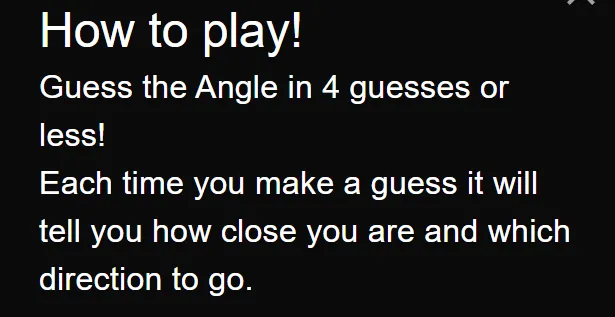
Angle Wordle swaps letters for degrees. Each morning a new puzzle draws two rays on screen, and your job is to name the exact angle they form. Valid guesses run from 1° through 359°, so reflex angles are fair game and wide arcs can look smaller than they really are. You get six attempts, the same pressure Wordle players know, applied to geometry instead of vocabulary.

After every guess the game answers with a temperature label and a direction arrow. Cold means you are still far off. Warm and Hot mean you are closing in. So close means within five degrees. The arrow tells you whether the hidden value sits above or below your number. Read the picture first, then let the feedback shrink the range until the correct degree locks in.

How to Play Angle Wordle

1
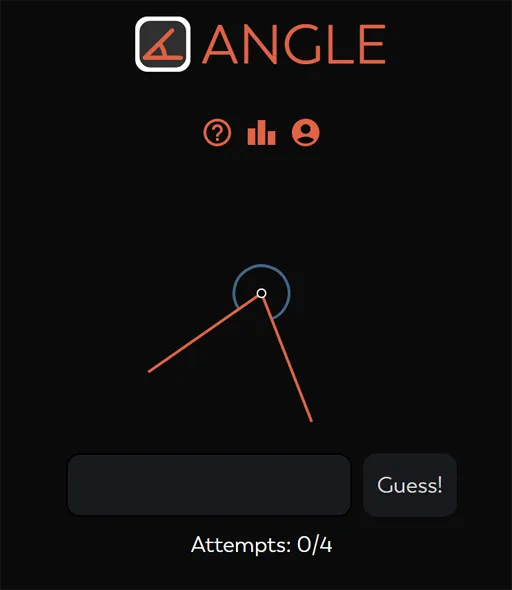
Angle Wordle puzzle showing two rays and degree input

Study the two rays and enter a degree guess

Look at how wide the angle opens between the two rays. Type a whole number from 1 to 359 and submit. There is no decimal input: the answer is always an integer degree value. Your first guess works best when it splits the plausible range rather than hugging an edge like 10 or 350.

2

Read the temperature hint and direction arrow

Cold means more than 30 degrees away. Warm means within 30. Hot means within 15. So close means within 5. An up arrow says the answer is higher than your guess; a down arrow says it is lower. Together they usually cut the remaining possibilities by roughly half, the same narrowing rhythm Wordle fans recognize from color tiles.

3

Land the exact angle within six tries

Keep adjusting until the game marks your guess correct. A new angle wordle puzzle arrives each morning around 6 AM local time. Solve it to extend your streak. Miss all six and the answer is shown, your streak resets, and you can share a spoiler free grid that shows only the hint pattern from each attempt.

Why angles are trickier than they look

Most people can spot a right angle on sight, but daily targets rarely land on clean multiples of fifteen. A ray pair that looks like 120 degrees might actually sit closer to 135, and obtuse angles above 180 are routinely undershot because the brain compresses wide arcs. Angle Wordle turns that visual bias into the puzzle itself.

Because guesses must be whole numbers, you cannot fine tune with decimals. That forces you to treat each hint as a range problem: if you guess 80 and see Warm with an up arrow, you know the answer lives somewhere above 80 but not more than 110 degrees away from it. The math is simple, yet the picture keeps pulling you toward the wrong integer.

Using hints like a narrowing search

Think of each temperature band as a fence around the answer. Cold still leaves a huge field. Warm shrinks it noticeably. Hot means you should commit to small steps. So close is the moment to try every integer within five degrees of your last guess before you waste a turn jumping too far.

The direction arrow prevents wasted guesses in the wrong half of the number line. A Warm result with a down arrow after guessing 120 tells you the target is below 120 but not below 90. Players who ignore the arrow and chase round numbers often burn attempts on values the hints already ruled out.

Opening guesses that actually help

Guessing 90 or 180 feels natural because those angles are easy to picture, yet they tell you little when the answer is nowhere near a benchmark. Mid range openers like 120 or 150 split the 1 to 359 space more evenly and tend to produce Warm or Hot feedback on the first try, which gives you a direction immediately.

On later turns, walk the range in steps sized to the hint. After a Hot reading, move five or ten degrees at a time rather than jumping twenty. The six guess limit is tight enough to punish sloppy leaps but generous enough that careful reading of the diagram usually finishes the job.

Streaks, sharing, and the daily rhythm

Angle Wordle follows the once per day cadence that made Wordle a habit. Stats and streak counts live locally, so returning on the same browser feels continuous. Clearing history or switching from phone to desktop starts a fresh record, which is worth knowing if you care about long runs.

The share grid uses emoji temperatures instead of numbers, so group chats can compare solve paths without spoilers. A row of Warm and Hot icons with a green check at the end tells a story about how confidently someone found the angle, even when nobody reveals the degree itself.

FAQs about Angle Wordle

You see two rays forming a mystery angle and type a whole number from 1 to 359. Each guess returns a temperature hint and an up or down arrow. Six tries are allowed to find the exact degree. No account is required to play.

So close means within 5 degrees. Hot means within 15. Warm means within 30. Cold means more than 30 degrees away. Pair the label with the arrow to decide whether your next guess should be higher or lower.

Yes. Any integer from 1 to 359 is valid, including angles larger than 180 degrees. Wide openings are a common trap because they are easy to underestimate, especially near the 180 degree mark.

A fresh angle appears every morning at 6 AM in your local time zone. One puzzle per day keeps the streak meaningful and gives everyone the same target to compare.

Yes, automatically in your browser on the device you use. No login is needed. Switch devices or clear site data and the streak starts over, since nothing is stored on a server.

Yes. The share button copies a grid of temperature emojis from your guesses with no degree numbers attached. Friends can see how efficiently you solved it without learning the answer.