
















Numberle
Word guessing Games like Numberle

Numberle

Numberle

Numberle applies the Wordle format to mathematics. Instead of guessing a hidden word, you are trying to identify a hidden equation. Each guess must be a valid mathematical expression using digits from 0 to 9 and the operators plus, minus, multiply, divide, and equals. You have six attempts to match the target equation exactly, with color feedback after every guess telling you which parts of your expression are correct.

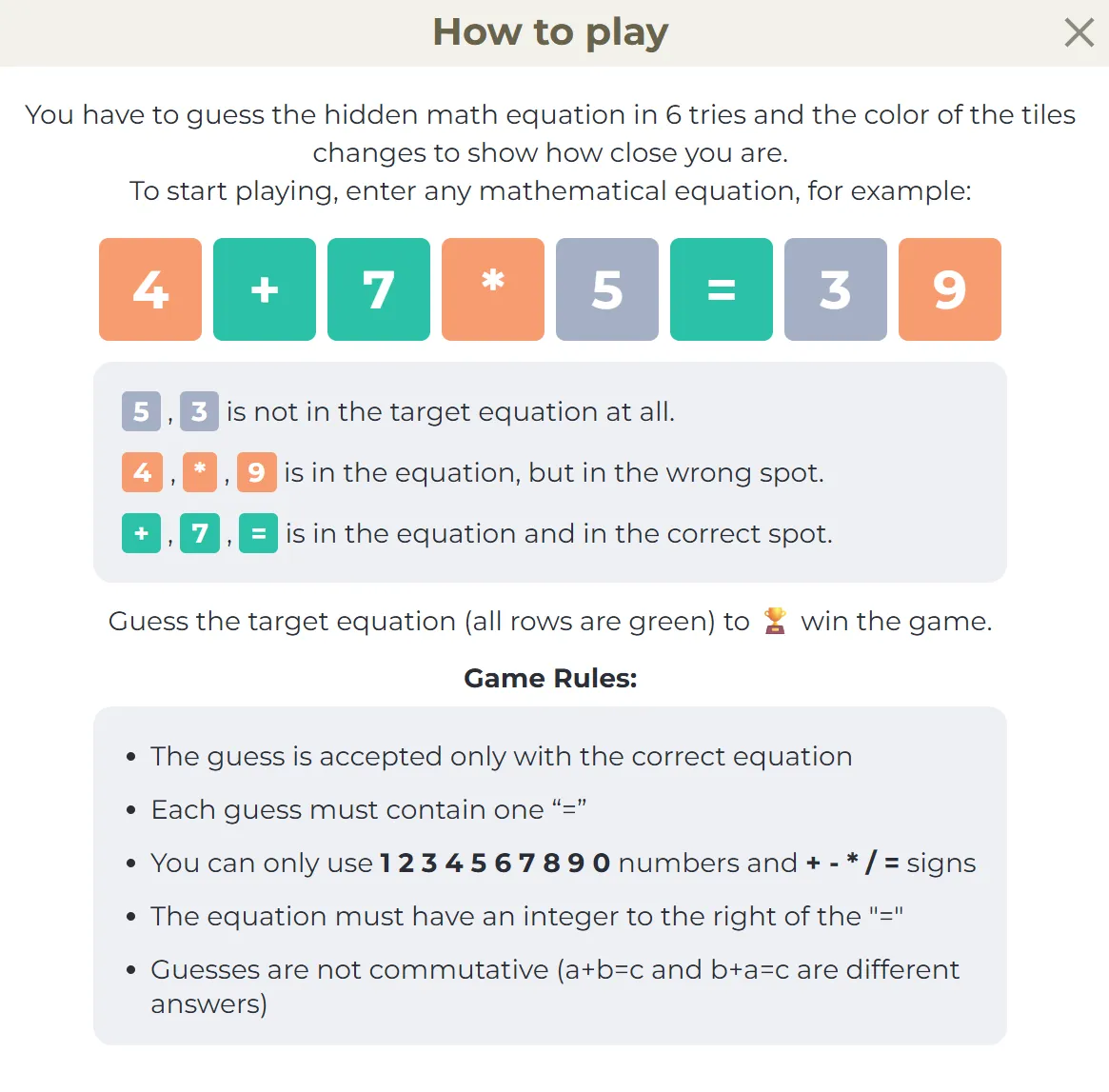
The feedback works on the same principle as letter-based word games but applied to individual characters in the equation. A green tile means the digit or operator is correct and in the right position. An orange or brown tile means it appears somewhere in the target equation but is currently in the wrong spot. A gray tile means that character does not appear in the equation at all. Reading these signals carefully across multiple guesses is how you home in on the answer.

The challenge comes from the need to satisfy two constraints at once. Every guess must be a mathematically valid equation, which limits the expressions you can try, while the feedback from previous guesses narrows down which digits and operators actually appear in the target. Balancing those two requirements is what makes Numberle genuinely different from any purely verbal guessing game.

How to Play Numberle

1
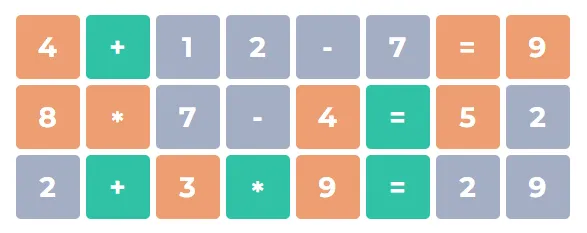
Numberle game board showing the first equation being entered

Enter a valid equation as your first guess

Type any correct mathematical equation into the first row using the digits 0 through 9 and the operators available. The equation must be arithmetically valid before you can submit it. Think of your opening guess as a way to gather information about which digits and operators appear in the target, rather than as a direct attempt to solve the puzzle immediately.

2
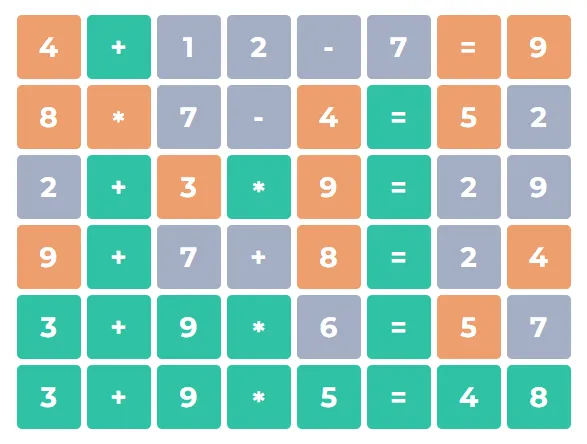
Numberle color feedback showing green, orange, and gray tiles after a guess

Read the color feedback on each character

After submitting, each tile changes color. Green means the digit or operator is in the correct position. Orange or brown means it exists in the target equation but is placed incorrectly in your guess. Gray means that character does not appear in the target at all. Use both the color and the position of each result together to decide what to try next.

3
Numberle completed puzzle with all tiles green showing the correct equation

Work toward the exact equation within six tries

Each subsequent guess must still be a valid equation, so you are always solving a real math problem while applying the clues from previous results. Confirmed green characters stay in place, orange ones need to move, and gray ones should be dropped. When every tile turns green, you have matched the target equation exactly and won the round.

Why valid equations change how you approach guessing

In a standard word guessing game, you can enter almost any combination of letters as long as the result is a real word. Numberle adds a harder constraint: every guess must be a correct equation. That requirement fundamentally changes what strategies are available to you. You cannot simply choose a guess that maximises the number of new digits you test if that combination does not produce a valid expression.

This means the early guesses in Numberle require a kind of dual thinking. You are simultaneously trying to construct something arithmetically sound and trying to place digits and operators in positions that will give you the most useful feedback. Players who approach the game with a flexible sense of arithmetic, comfortable rearranging numbers into different valid expressions on the fly, tend to make faster progress than those who find the dual constraint harder to manage.

Reading position feedback more carefully than color alone

The color of a tile in Numberle tells you whether a character is present in the target, but the position of that tile tells you where it is not. A digit that comes back orange in the third slot is confirmed to be somewhere in the equation, just not in slot three. That is actually a significant piece of information, because it eliminates one possible position for that character and leaves only the remaining slots as candidates.

Players who log this positional information mentally, or keep a rough note of confirmed placements and ruled-out positions, consistently make better use of their six guesses than those who focus only on which characters are present. The combination of color and position is the full signal, and using both halves of it is what separates efficient solvers from those who circle the answer without quite reaching it.

Thinking about equation structure early

Most equations in Numberle follow a predictable structural pattern: numbers on either side of an operator, followed by an equals sign and a result. Thinking about where the equals sign is likely to appear and how many digits the result might contain gives you a structural framework before you have confirmed any individual characters. That framework can make your second and third guesses considerably more efficient.

For example, if your first guess places the equals sign in a certain position and it comes back green, you have immediately constrained the structure of all subsequent guesses. Conversely, if it comes back gray or orange, you know the equals sign sits elsewhere and can adjust the structure of your next equation accordingly. Paying attention to the operators as carefully as the digits is what separates players who solve the puzzle in three or four guesses from those who use all six.

Why math puzzle games train different skills

Word guessing games and math guessing games look similar on the surface but exercise genuinely different cognitive skills. Word games primarily test vocabulary recall and pattern recognition within language. Numberle adds a layer of arithmetic constraint that requires you to hold a valid equation in mind while simultaneously processing feedback from previous guesses. The two tasks compete for working memory in a way that purely verbal puzzles do not.

Regular play tends to improve the speed at which players can construct valid equations under mild pressure, and it builds the habit of reading feedback more systematically rather than guessing on instinct. For anyone who enjoys both number puzzles and word games, Numberle sits at an interesting intersection of both, offering something that neither type delivers on its own.

FAQs about Numberle

Numberle is a math-based puzzle game where you have six attempts to guess a hidden equation. Each guess must be a valid mathematical expression, and color-coded feedback after every attempt tells you which digits and operators are correct and in the right position.

You can use the digits 0 through 9 and the arithmetic operators for addition, subtraction, multiplication, division, and the equals sign. Every guess must form a valid, correct equation before the game will accept it.

Green means the digit or operator is in the correct position. Orange or brown means it appears in the target equation but is placed incorrectly in your current guess. Gray means that character is not in the target equation at all. Applying all three signals together across multiple guesses is how you narrow down the answer.

You get six guesses per round. Each one must be a mathematically valid equation. If you do not match the target exactly within six attempts, the game ends and the correct equation is shown.

Numberle only accepts equations that are arithmetically correct. If the expression you entered does not balance mathematically, the game will prompt you to enter a valid one instead. This is by design, since requiring valid equations is part of what makes the puzzle work.

Yes. After the round ends, you can copy your result or share it directly. The summary shows the color pattern of your guesses without revealing the actual equation, so you can post it without spoiling the answer for others.

Basic arithmetic is enough to play. The equations use simple operations that most people are comfortable with. The main skill the game tests is pattern recognition from the color feedback, not advanced mathematical knowledge.

No download or account is required. Numberle runs entirely in your browser and is free to play on any device with an internet connection.