


Kilordle
Word guessing Games like Kilordle

Kilordle

Kilordle

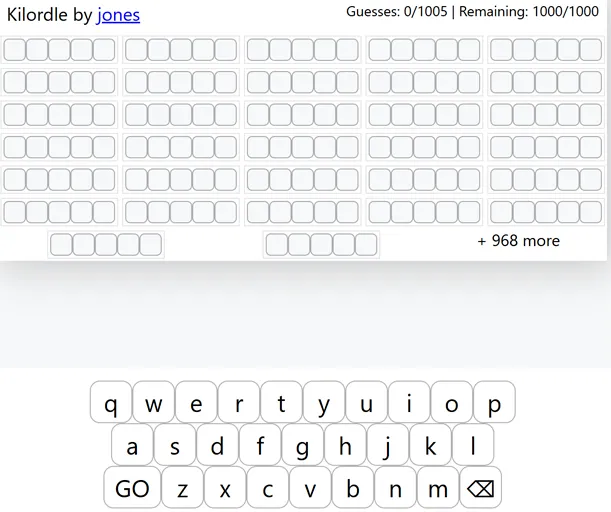
The name kilordle borrows kilo for one thousand, and the screen earns that prefix fast. You are not staring at a single five letter answer. You are feeding one typed word into a vertical river of miniature boards, each hiding its own solution, each painting its own green, yellow, and gray feedback while your guess stays identical on every row. One keyboard stroke nudges the entire stack at once.

What makes the rules stranger is how a board counts as finished. You rarely need to spell the exact hidden word. Lock the right letter in slot one, slot two, and onward using any valid guesses that prove those positions, and that mini puzzle closes even if your entries looked nothing like the final answer. With only 1005 total attempts for 1000 targets, the margin is thin, the scroll bar becomes your map, and a full clear can swallow an afternoon.

How to Play Kilordle

1
Kilordle interface showing one guess applied across many stacked word boards

Submit a guess that hits every board

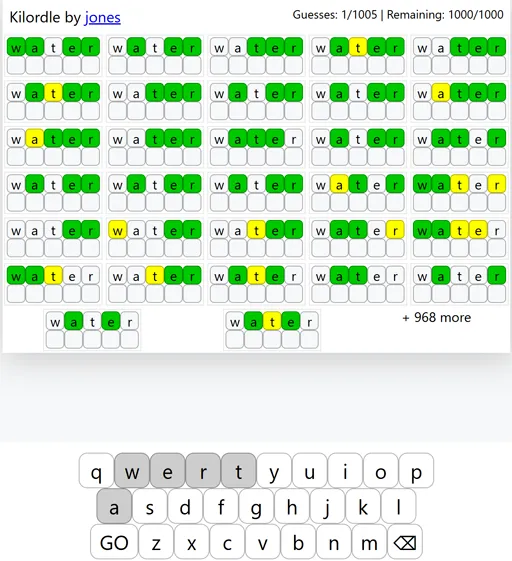
Type a five letter word and press Enter. Kilordle copies that row onto all 1000 active grids simultaneously. Each board compares the guess against its private answer and colors tiles on its own. Early words should spread common letters so hundreds of rows light up at once.

2

Scroll the stack and clear solved rows

Drag or scroll through the tall column of boards. Focus on grids where several green tiles already sit, or where yellow hints narrow the shape. A board vanishes once every position is confirmed, even if you never typed the literal solution word.

3

Watch the counter and pace your 1005 tries

The header tracks how many boards remain and how many guesses you have left. You receive exactly five more attempts than there are words, so wasted rows hurt. Return to stubborn grids near the end, use the saved session if you step away, and push the completion meter toward all 1000.

One keystroke, a thousand reactions

Kilordle treats your keyboard like a broadcast tower. The same five letters land on board 1, board 400, and board 999 in the same second, yet each grid answers independently because the hidden words differ. That scale changes how you pick openers. A guess that looks merely decent on a solo grid might suddenly turn useful on three hundred strangers that share its vowels.

The scrollable wall is not decoration. It is the workspace. You sweep downward, hunt for clusters of green, knock out easy victories, and leave prickly combinations for later when the global letter pool is richer. The rhythm feels closer to clearing tabs than solving a single riddle.
Winning a row without naming it

Many newcomers assume kilordle demands 1000 perfect spellings. The actual rule is kinder and weirder. Each mini board cares about positions, not vanity. Once every slot is verified, the row disappears, even if your trail of guesses zigzagged through unrelated vocabulary.

That structure rewards flexible thinking. You might park a correct A in column two using PLANT, then confirm T in column five using BUILT, never touching the true solution at all. Veterans lean on that freedom to burn fewer rows on boards that would otherwise stall the counter.

Three moods across one marathon

Early guesses are reconnaissance. You are buying alphabet coverage, not chasing individual names. The middle stretch is factory work: scroll, spot patterns with three or more greens, close them, scroll again. The final handful of attempts is triage on whatever survived your sweep.

Milestone counts at 100, 250, 500, 750, and 900 boards give mental checkpoints during the grind. They do not change the rules, but watching the solved total climb keeps the session from feeling like an endless beige column.

A puzzle that respects real life

Kilordle assumes you will pause. Saved progress, a progress percentage, and the sheer length of the run make it friendly to background music, podcasts, or split shifts across evening and morning. It is the sort of challenge people boast about finishing precisely because most never do.

If you want a vocabulary test that stays polite for five minutes, look elsewhere. If you want kilordle, bring patience, a comfortable mouse wheel, and the stubborn satisfaction of watching the last few boards blink out hours after you started.

FAQs about Kilordle

The stack holds 1000 separate five letter puzzles. Every guess you enter is judged against all of them at the same time, which is why the page feels less like one game and more like a control room.

You get five more attempts than there are boards. That tiny buffer sounds generous until you remember each stubborn row can eat multiple probing words. The limit turns the session into careful budgeting instead of endless typing.

Usually no. A board clears when you have confirmed the correct letter in each position through valid guesses, even if those guesses were different words. If the hidden word were CARTS, proving C in first place with one entry and R in third with another can still finish that line.

Green locks a letter in the right slot for that specific board. Yellow means the letter belongs in the answer but sits elsewhere on that board. Gray removes it from that board only. Colors never bleed between grids, so two boards can paint the same guess differently.

Yes. Long runs expect breaks. The browser session keeps your solved boards and remaining guesses, so you can walk away for coffee, stretch, and resume scrolling without restarting the entire kilo stack from zero.

Most players report several hours for a complete run, with first attempts sometimes stretching toward a full day split across sessions. Speed focused solvers who already know the rhythm can finish faster, but the design assumes endurance rather than a quick lunch break.