




4 Letter Wordle
Games similar to 4 Letter Wordle

4 Letter Wordle

4 Letter Wordle

Most people know Wordle as a five-letter game, but the four-letter version carries its own distinct feel. With one fewer column on the board, every guess cuts deeper and wrong assumptions get punished faster. The smaller search space sounds forgiving right up until you realize how many short English words share the same two or three letters. That friction is what makes it satisfying rather than trivial.

On this page you can play as many rounds as you want. There is no daily cap, no login, and nothing to install. When one game ends you simply start the next, which makes it a good fit for a quick mental reset or a longer focused session.

How to Play 4 Letter Wordle

1
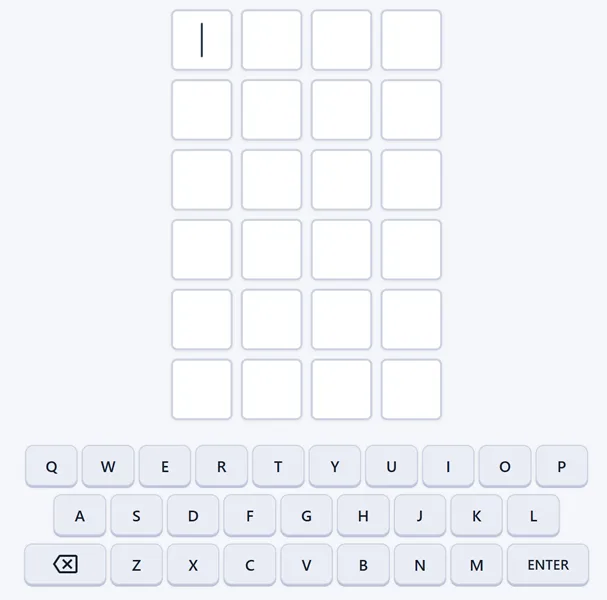
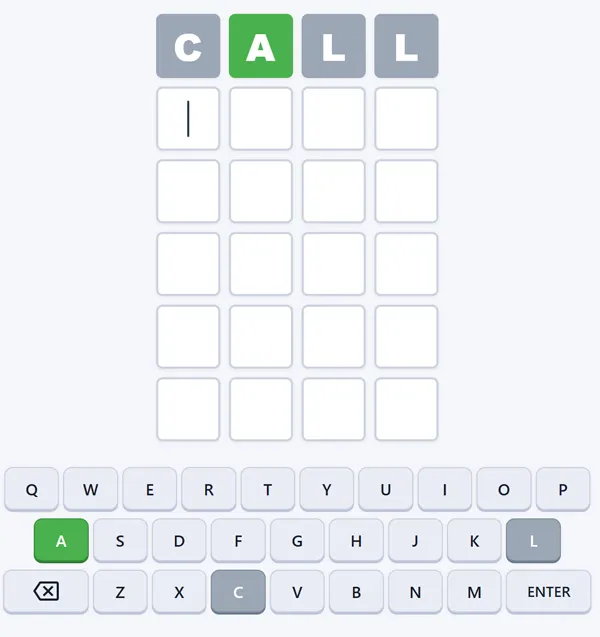
4 Letter Wordle opening guess on the game board

Type your opening word

Pick any real 4-letter word and type it using the on-screen keyboard or your physical keyboard. A strong opener covers common vowels and consonants at the same time.

2

Read the colour feedback

After pressing Enter, each tile changes colour. Green means the letter is correct and in the right position. Yellow means the letter is in the word but placed elsewhere. Grey means the letter does not appear in the word at all.

3

Refine with each guess

Use the colour clues to narrow the options. Lock green letters in place, try yellow letters in other positions, and avoid grey letters entirely. You have up to six attempts to reach the answer.

What makes short words tricky

Four-letter words are everywhere in English, which sounds like an advantage until you start listing candidates. Common letter clusters like -ack, -ine, -ore, and -ake each anchor dozens of words, so a yellow clue that places a vowel somewhere in the word can still leave a wide-open field. The board compresses every mistake more visibly than a five-letter game: one careless guess can wipe out a full row while advancing your understanding very little.

Short words also tend to share endings rather than beginnings. If you have confirmed two letters and both sit at the back of the word, think about how many four-letter words end that way and vary the front pair with your next guess. Working backwards from a known suffix is often faster than trying to nail the first letter when the pool is still large.

Building a reliable opening strategy

A good first guess for any Wordle variant does two things: it samples high-frequency letters and it spreads them across as many positions as possible. For four-letter play, words like ROSE, PINE, TALE, or BOAT give you a useful mix of vowels and common consonants without repeating any letter. You are not trying to guess the answer on move one. You are buying information.

If your opener returns two or three grey tiles, resist the urge to anchor hard on the confirmed letters right away. A second guess that deliberately tests new letters can clarify the picture faster than squeezing variations out of one confirmed letter. Players who gather broad information in the first two guesses routinely find the answer in three or four total attempts.

Using yellow clues without wasting guesses

A yellow tile tells you two things at once: the letter is present, and it is not in that column. Both pieces of information matter. Many players remember the first part and forget the second, then repeat the same position in their next guess and lose a turn to an invalid deduction.

When you have two yellow letters, think about how they could coexist in the four available slots given the positions already ruled out. Sometimes a pair of yellow letters points to just one or two plausible arrangements. Finding that layout early can collapse several turns of exploration into a single confident guess.

The history behind the game

Wordle was built by Josh Wardle, a software developer based in New York, as a personal project for him and his partner. After sharing it with family during late 2021, word spread quickly online. The tipping point came when Wardle added a feature that let players paste a compact emoji grid of their result into social media without revealing the answer. That mechanic turned a solitary puzzle into a shared daily ritual, and within weeks the game had millions of players. The New York Times acquired it in early 2022.

The four-letter variant grew out of player demand for shorter, faster sessions and a slightly different challenge. Wordles.org offers it as an unlimited mode so you can play whenever the mood strikes, compare results with friends, or run through several rounds in a single sitting without any restriction.

FAQs about 4 Letter Wordle

The target word contains four letters instead of five, so the board has four columns. The guessing rules are identical: six attempts, colour-coded feedback after each guess, and every entry must be a real dictionary word.
Yes. Unlike the original Wordle, this version imposes no daily limit. You can start a new game the moment the current one finishes, making it easy to play at your own pace.
Your wins, streaks, and guess distribution are stored locally in your browser. You can check them at any time by clicking the statistics icon inside the game.
Any real 4-letter English word in the dictionary. Abbreviations, proper names, and random letter strings are not accepted. If the board rejects your entry, try a different word.
Yes. Hard mode requires you to use all confirmed letters in every subsequent guess. It prevents you from testing new letters at the cost of information, which sharpens the challenge considerably.
Yes. Use the Create button inside the game to enter a specific word. The game generates a shareable link so your friends can guess the same word you chose.
No. The game runs entirely in your browser. Open the page and start playing immediately on any device, whether that is a phone, tablet, or desktop.