













Costodle
Word guessing Games like Costodle

Costodle

Costodle

Costodle is a daily price-guessing game built around the Costco product catalogue. Each day a new item from the store is presented with its price hidden, and you have six attempts to figure out what it costs. The concept borrows from word-guessing games: every guess generates feedback that tells you whether the real price is higher or lower than what you entered, letting you zero in on the answer with each attempt.

What makes the game genuinely interesting is how wide the Costco inventory runs. One day you might be guessing the price of a jumbo pack of paper towels, the next it is an outdoor furniture set or a bulk bag of coffee. The variety keeps returning players engaged because the pricing logic shifts depending on the category, and nothing you learn from one round fully prepares you for the next.

The feedback system is straightforward but effective. An upward arrow means your guess was too low. A downward arrow means you went too high. A green tick means you landed within five percent of the actual price, which counts as a win. That five-percent margin makes the game approachable without removing the challenge entirely, since even a small error on a high-ticket item can still leave you well outside the winning zone.

How to Play Costodle

1
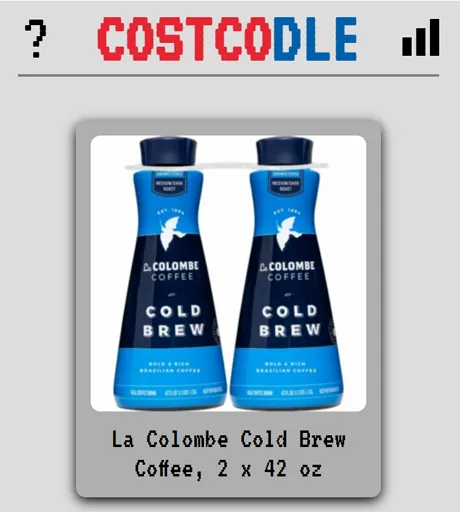
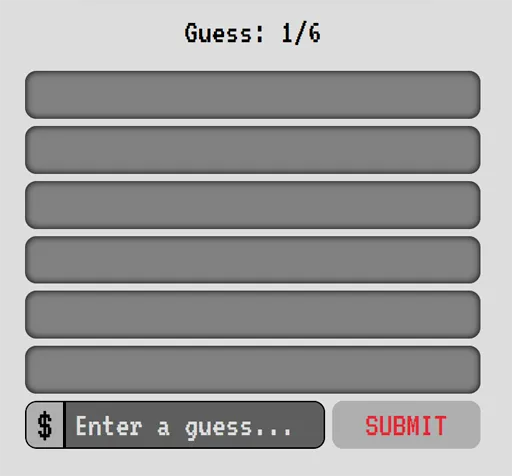
Costodle game screen showing a Costco product and the price input field

See today's product and enter your first price guess

When the game loads, a Costco product is displayed without its price. Type what you think it costs into the input field and press Submit. There is no minimum or maximum you have to stay within; your opening guess is simply a starting point for the feedback to work from. Think about the product category and what you know about Costco's typical pricing before committing.

2
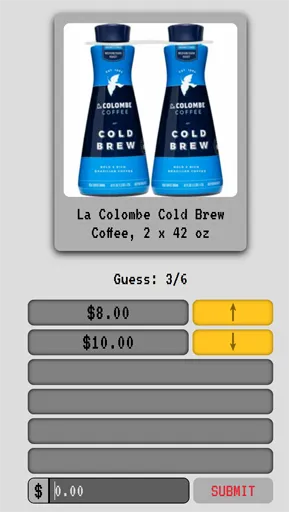
Costodle feedback showing color indicators and directional arrows after a price guess

Read the color and arrow feedback after each guess

After each submission, the game shows a colored indicator alongside an arrow. Red with an upward arrow means the actual price is higher than your guess. Red with a downward arrow means you guessed too high. Yellow means you are in the right ballpark but not close enough. Green signals that your guess landed within five percent of the real price and you have won the round.

3
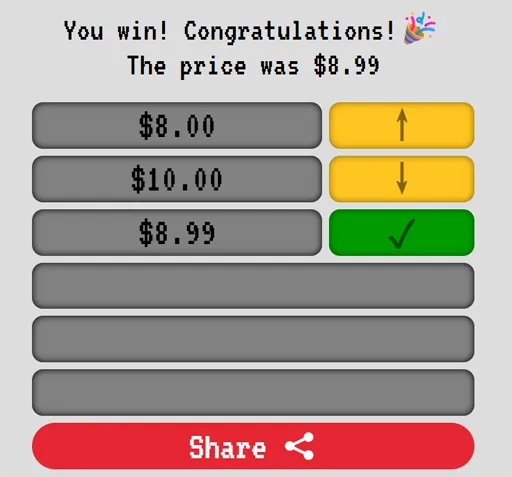
Costodle win screen showing the correct price and a share button

Adjust your next guess and work toward the price

Use the direction and color from each result to narrow your range. You have six guesses in total, so there is room to move methodically rather than jumping wildly between numbers. Once you hit the target within five percent, the round ends with a win. After the game concludes you can copy your result to share with others without revealing the actual price.

Why pricing knowledge is harder than it looks

Most people who shop at Costco regularly have a rough sense of what things cost, but Costodle quickly reveals how imprecise that sense tends to be. The difference between a product priced at eighteen dollars and one at twenty-four dollars might feel small in person, but in a game where you need to land within five percent, that gap is the difference between a yellow result and a green one. The feedback trains you to think about price more precisely than a typical shopping trip ever requires.

Products that seem easy to guess often turn out to be the most deceptive. Everyday staples like cooking oil or laundry detergent come in Costco-sized quantities that most people have never purchased before, which means the unit logic that usually anchors price guesses does not apply in the same way. Players who do well tend to think in terms of what they know about Costco's pricing structure rather than just the category the product belongs to.

Getting the most out of the feedback arrows

The arrows in Costodle are more useful than they first appear. When a red upward arrow comes back on your first guess, the natural instinct is to jump by a large amount. That approach works when the real price is dramatically higher than your estimate, but it often leads to overshooting and switching from one red direction to the other without making real progress.

A more efficient strategy is to treat the color alongside the arrow as a combined signal. Red with an upward arrow tells you the price is higher, but red also tells you that you are still quite far from the target. Yellow with an upward arrow means the price is slightly above your guess and you are close. Adjusting in smaller steps once you see yellow gives you a much better chance of landing in the green within your remaining attempts.

Thinking about Costco's pricing patterns

One thing experienced Costodle players notice is that Costco tends to maintain consistent pricing logic within product categories. Bulk grocery items usually sit within a fairly predictable range relative to their standard retail counterparts. Electronics and appliances often reflect a modest discount from typical retail but not always as steep as shoppers expect. Seasonal items can shift considerably depending on the time of year.

Building a mental map of these patterns does not require memorising prices. It comes from paying attention to the feedback over many rounds and noticing where your estimates tend to drift high or low. Players who approach the game as a learning exercise tend to improve more steadily than those who treat each guess as an isolated shot in the dark.

Playing consistently over time

The daily format creates a natural rhythm that works well for a game built on price knowledge. Because a new product appears each day, there is no single strategy that carries you through every round unchanged. Some days the product will be something you have purchased before and feel confident pricing. Other days it will be something outside your usual shopping habits entirely, and the feedback will have to do more of the work.

Over time, the results across many different product types give you a useful map of where your pricing knowledge is strong and where it has gaps. Costodle is not just a game you play once and move on from. The daily variation and the straightforward feedback loop make it the kind of thing that gets more interesting the longer you stay with it.

FAQs about Costodle

Costodle is a daily price-guessing game where a Costco product is revealed and you have six attempts to guess its price. Color-coded feedback and directional arrows after each guess guide you toward the correct answer.

After each guess, the game shows a colored result alongside an arrow. Red with an upward arrow means the real price is higher than your guess. Red with a downward arrow means you guessed too high. Yellow means you are relatively close. Green means your guess was within five percent of the actual price, which counts as a win.

You get six guesses to identify the price within the winning range. If none of your six attempts lands within five percent of the real price, the round ends and the correct answer is revealed.

Yes. A new product from the Costco catalogue is loaded each day. The variety spans groceries, household goods, electronics, seasonal items, and more, so the pricing knowledge needed shifts from one round to the next.

No. A guess that falls within five percent of the actual price is accepted as a win. On a product priced at around twenty dollars, that margin is about one dollar in either direction, which gives you a realistic target to aim for without requiring perfect knowledge.

Yes. Once the round ends there is a Share button that copies a summary of your result to the clipboard. The summary shows how many guesses it took and the color pattern without disclosing the actual price, so you can post it freely without spoiling the game for others.

The game draws from across the Costco inventory, which includes bulk grocery items, cleaning and household supplies, electronics, clothing, seasonal goods, and more. Because Costco stocks such a wide range, no two rounds feel the same in terms of the pricing knowledge they require.

No download or account is required. Costodle runs directly in your web browser and is free to play on any device with an internet connection.