













Pokle
Word guessing Games like Pokle

Pokle

Pokle

Pokle is a daily poker deduction puzzle built around Texas Hold'em logic. You are not betting chips or bluffing opponents. You are reconstructing the exact five community cards that would explain a fixed three-player table. Six submission rows, tap-to-select cards for the flop, turn, and river, then submit to see how close your board matches the hidden answer.

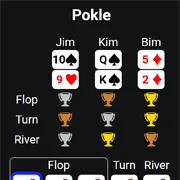
What makes pokle feel different from a vocabulary grid is the evidence stack sitting beside the felt. Each player keeps a visible hole card pair, and a ranking table tracks how their made hands change as the board grows from three cards to five. Green and yellow marks on your guess tell you when rank and suit both hit, or when only one of them does. Poker knowledge helps, but careful reading of the table often matters more than memorizing every combo name.

How to Play Pokle

1
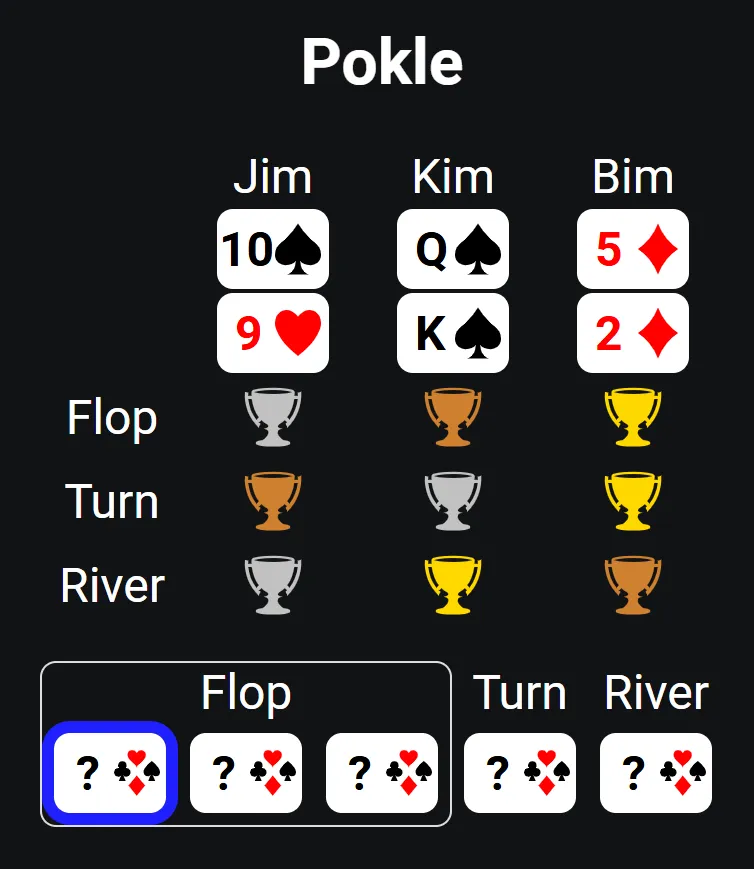
Pokle screen showing three player hands and the ranking table

Study the hands and the ranking table

Before you touch the board slots, look at the three players and how their hand strength is listed at the flop, turn, and river stages. Pokle assumes a real Hold'em deal: the community cards you pick must make those rankings possible. The puzzle also rules out stray kickers on the board. Every rank that appears in the five community cards must show up in at least one player's best hand during at least one street.

2
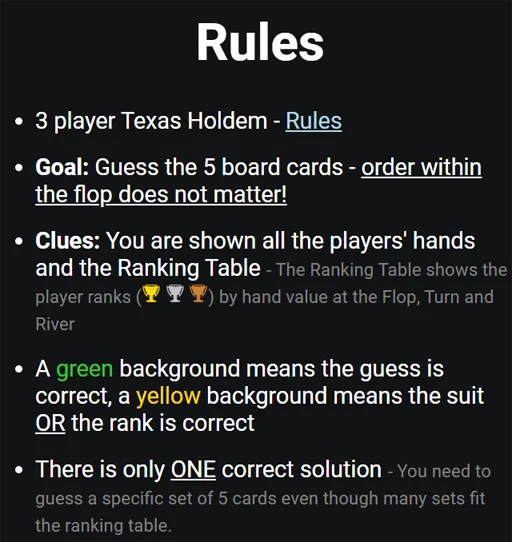
Pokle board guess with green yellow and gray card feedback

Select five cards and submit your board

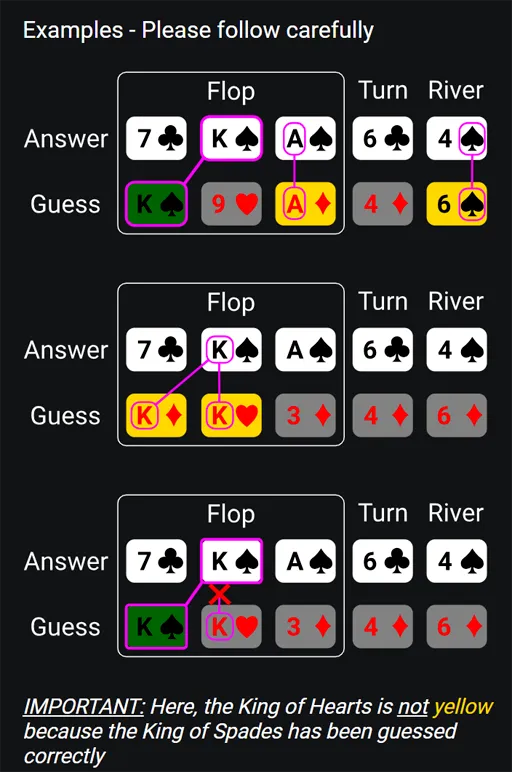
Tap cards to fill the flop, turn, and river positions, then press submit. You do not need to enter them in a special typing order before submitting. Pokle evaluates the full five-card board together. Green marks mean both rank and suit are correct for that slot. Yellow means you matched rank or suit but not both. Gray means the card is wrong in every way. Confirmed greens carry forward into your next row automatically.

3

Use six rows to lock the daily answer

You get six attempts on the daily pokle puzzle. Even when several boards could satisfy the ranking table in theory, only one specific five-card sequence is the official solution. On later streets, getting the rank right on the turn or river may auto-correct the suit so a near miss still counts as progress. Work from the strongest shown hands first, then narrow suits using yellow feedback until the full board clicks into place.

Deduction at the table instead of the dictionary

Most tile puzzles ask you to hunt spelling patterns. Pokle asks you to reverse engineer a shared board from partial information, the same mental muscle used when you try to put someone on a range after seeing a showdown. The interface borrows Wordle's colored feedback rhythm, but the objects are playing cards and the clues come from hand rankings rather than a word list.

That shift gives pokle a distinct audience. Casual players can lean on the ranking table as a structured hint system. Players who already know Hold'em notation will recognize why a flush draw on the flop might force certain suits later. Both paths lead to the same five-card answer.

Why three players change the math

A single hero hand against an unknown range would leave too much room to guess. Pokle locks three visible pairs and shows how each one improves across streets. When one player jumps from pair to two pair on the turn, the board you propose must explain that jump. When another player stays flat, that is informative too.

The no-kicker rule tightens the search further. You cannot pad the board with an ace nobody uses just because it looks scary. Every rank in the final five must earn its spot in someone's made hand at some point. That constraint turns pokle into a logic puzzle with teeth, not a free-form card picker.

Reading greens and yellows on suits

Green is unambiguous: rank and suit both belong in that slot. Yellow splits the difference and is often where pokle sessions are won or lost. A yellow on the third flop card might mean the rank is right but the suit is wrong, or the opposite. Tracking which half matched lets you swap the other half without throwing away the progress.

The suit auto-correct on turn and river cards prevents a frustrating endgame where you knew the rank cold but burned a row hunting hearts versus spades. Pokle still expects you to earn ranks through the ranking table. It just removes a little friction once you are clearly pointed at the right value.

A daily board worth one clean solve

Pokle posts one puzzle per day, which fits the rhythm of other daily games without turning into an endless session. Six rows are enough to recover from a sloppy flop guess yet tight enough that random tapping rarely survives to the river. Many players treat the ranking table like a notebook, scanning top hands first and only then filling suits.

When the board finally locks, the reveal feels less like luck and more like proof. Every green card had to agree with three players and three streets of rankings. That satisfying click is why pokle keeps pulling poker-curious solvers back even when they do not play real stakes online.

FAQs about Pokle

You are deducing the five community cards for a fixed three-player Texas Hold'em scenario. The flop, turn, and river together must match the ranking table and the visible hole cards.

You have six submission rows on the daily puzzle. Correct cards marked green are locked into the next row automatically, so later attempts build on confirmed information.

Green means both rank and suit are correct for that board slot. It is the strongest confirmation the game gives on a single card.

Yellow means you matched either the rank or the suit, but not both. Use that partial hit to adjust the card while keeping the part that already fits.

It shows how each player's best hand ranks on the flop, turn, and river. Comparing those rows tells you which ranks must appear on the board and which made hands the five cards need to support.

No. Every rank on the five community cards must participate in at least one player's hand at some stage. Random high cards that nobody uses will not be part of the solution.

Yes. If you place the right rank on the turn or river but pick the wrong suit, pokle may fix the suit for you and still treat the slot as solved. That keeps late-street guesses from feeling like pure guesswork.