



Horsle
Word guessing Games like Horsle

Horsle

Horsle

Horsle looks like a normal five-letter guessing game until you read the line under the grid: the word is always HORSE. Not sometimes. Not on special days. Every round, every puzzle number, the answer sits there waiting while the board acts like it has a secret to protect. That is the whole joke, and it lands harder than it has any right to because your hands still want to play seriously.

You get six rows, real dictionary words, and the same green, yellow, and gray tiles people recognize from daily word puzzles. Horsle accepts any valid guess, lights up the feedback, and lets you wander through the grid like you are solving something hidden. The only winning word is HORSE. Type it on row one and you are done in ten seconds. Drag it out across three or four rows and the finished board looks suspiciously like hard work. Both versions are correct. Horsle does not grade effort. It grades presentation.

How to Play Horsle

1
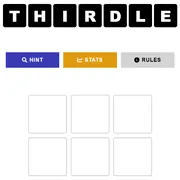
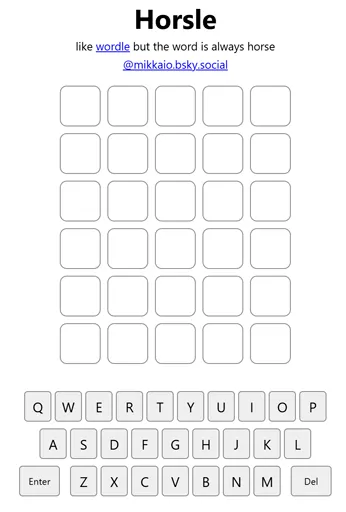
Horsle opening grid with the spoiler message visible

Start with a word that is definitely not the answer

The opening screen shows the familiar grid and a message that spoils the ending on purpose. Pick a five-letter word that sounds like you are thinking, not like you already know where this is going. MARES, STALL, NEIGH, and BRONC all give the board something to react to. The colors will still update honestly. Horsle is not broken. It is performing.

2
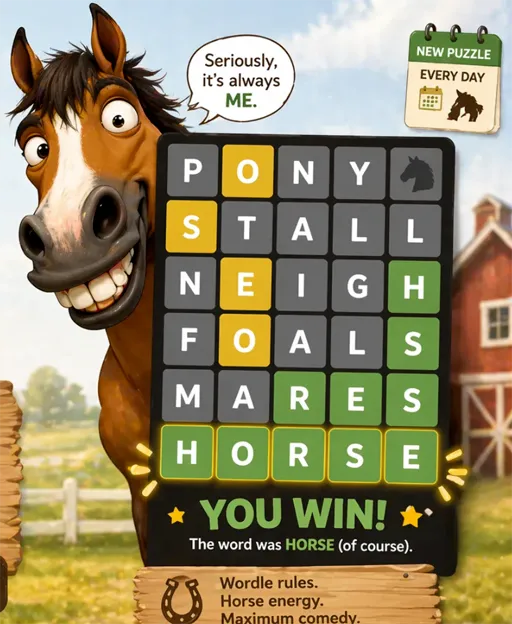
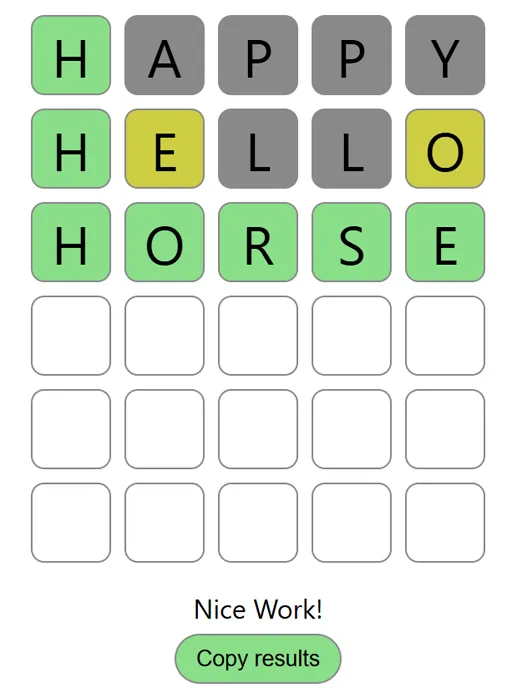
Horsle board with color feedback after multiple guesses

Let the tiles build a story

Each guess returns normal feedback. Green locks a letter in place, yellow says the letter belongs somewhere else, gray removes it from the running. Because the target is fixed, those colors are really showing how close your throwaway word sits to H-O-R-S-E. A strong second guess shares a letter or two without giving the game away. A weak one fills the row with gray and makes the next step feel dramatic. You are directing a short scene, not hunting a mystery.

3

Finish on HORSE and send the grid

When the board has enough color for the result to look respectable, type HORSE and watch the row go green. Horsle records the attempt count, puzzle number, and colored square pattern exactly like a serious daily game. Copy that summary and drop it in a chat. The text never says horse out loud. Your friend opens the link, plays one round, and realizes why everyone ended up at the same place.

A spoiler sitting in plain sight

Most word puzzles hide the answer and ask you to earn it. Horsle flips that relationship on its head. The site tells you the word before your first keystroke, then hands you the full toolkit anyway: six rows, a keyboard, and color rules you already understand from years of daily grids. The mismatch between what you know and what your fingers want to do is where the laughter starts.

That setup also explains why horsle spreads well in group chats. Nobody is gatekeeping a secret solution. The entertainment is watching someone realize the game was never pretending. A friend who lives inside word puzzles will recognize the layout in seconds. The horse reveal follows right after, usually with a short pause and then a repeat attempt that takes way too long on purpose.

Turning six rows into a tiny performance

There is a real skill here, but it is theatrical rather than lexical. A one-row finish is efficient and slightly rude. A three-row finish can look like steady deduction if you pick intermediate words that share letters with HORSE without spelling it outright. A four-row finish can resemble a comeback story, especially if an early guess comes back mostly gray.

Think of each row as a line in a very short script. Row one establishes confidence. Row two introduces doubt. Row three can either deepen the fake struggle or set up the final reveal. When HORSE finally lands, the green row feels earned even though you knew the ending before you started. That tension between knowledge and presentation is what keeps horsle interesting after the first laugh fades.

Words that make the board look busy

You do not need equine expertise to play horsle well. You need words that interact with H, O, R, S, or E in ways the tiles can illustrate. Short, common five-letter entries often work better than obscure terms because they produce readable color patterns without sending you to a dictionary.

Some players treat the opening guess like a dare and type something loudly unrelated to horses just to watch the board go gray. Others lean into the theme with stable vocabulary and let yellow tiles stack up early. Neither approach is wrong. Horsle scores nothing for difficulty. It only leaves behind a grid your friends can screenshot and argue about.

Why the shared grid matters more than the win

After the round ends, horsle gives you the same compact result card daily puzzle fans already know how to read. Colored squares line up in a neat stack. The attempt number sits beside the puzzle ID. Nothing in that text explains the joke, which is deliberate. A recipient sees a familiar format, assumes a normal solve, and opens the link out of curiosity.

That moment of recognition is the second half of the experience. The first half is playing through the board yourself. The second half is watching someone else discover that the answer was never in doubt. Horsle is short, repeatable, and built for that handoff. Play it once for the blunt version, play it again when you want the share card to look impressively patient.

FAQs about Horsle

It is both. Horsle uses a real keyboard, valid five-letter entries, and legitimate tile feedback. The twist is that the answer is fixed to HORSE, so the puzzle is less about deduction and more about how you choose to reach an ending everyone already knows.

Yes. Typing HORSE on the first row ends the round immediately. Plenty of players do that when they are in a hurry. The slower, sillier routes are there for people who want the shared grid to look like a struggle.

The puzzle number and date update daily, but the word stays HORSE. Tomorrow's board is the same punchline with a fresh number attached, which is part of the humor.

Horse-adjacent words work best for comedy. Try terms tied to riding, stables, or tack. Even plain words that share one or two letters with HORSE can produce a grid that looks thoughtful. The goal is a believable path, not a clever vocabulary flex.

The share summary looks like a normal daily puzzle result: attempt count, puzzle ID, and a block of colored squares. It does not name the answer in text. Someone who has not played yet sees a serious-looking score and clicks through to learn why the grid always resolves the same way.

Horsedle tests knowledge of horse breeds and names with a hidden answer that really changes. Horsle is a fixed-answer parody. The board borrows Wordle's shape, but the point is the joke, not equine trivia.

No. Horsle runs in the browser on desktop and mobile. Open the page, tap Play Now, and the board loads without a download or login.