


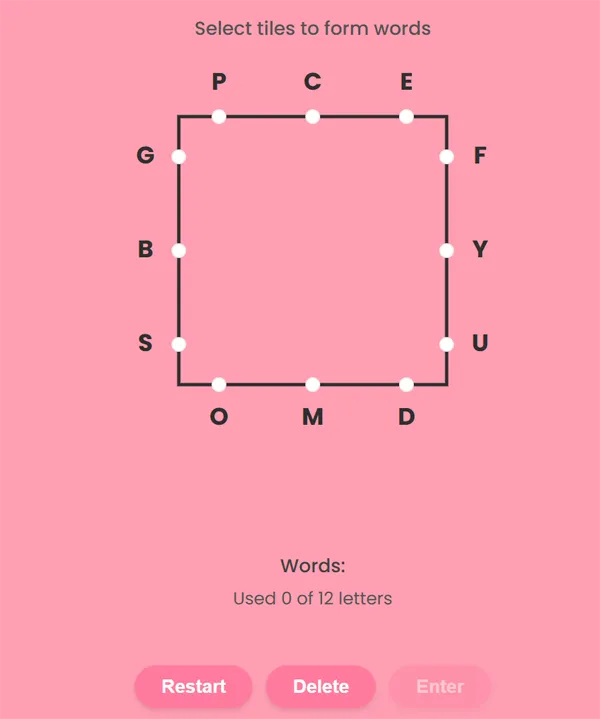
The game presents a square with 12 letters: three on the top edge, three on the right, three on the bottom, and three on the left. You build words by selecting letters in order, but each time you pick a letter you must switch to a different side of the box for the next one. So if you start with a letter on the top, your second letter has to come from the left, right, or bottom—never the top again until you have used a letter from another side. This constraint is what gives Letter Boxed its character: you are not just finding words, you are finding words that can be drawn as a path that bounces between the four sides.
Words are chained by shared endpoints. The last letter of your first word becomes the first letter of your second word; the last letter of the second becomes the first of the third, and so on. A classic example is THY → YES → SINCE: each word starts where the previous one ended. Your aim is to cover all 12 letters at least once. A perfect solution uses every letter exactly once in one long chain, but that is not always possible—so in practice you try to use all letters in as few words as you can. Fewer words mean a more efficient and often more satisfying solve.